Resistance Band Standing Row
The Resistance Band Standing Row is a horizontal pulling exercise performed on your feet, with a resistance band anchored at roughly chest height in front of you. You take one end of the band in each hand, step back until the band is taut with your arms extended, and pull your hands back toward your lower ribs while keeping your torso upright. Because you are standing rather than seated, your legs, hips, and core all contribute to keeping your body steady while your upper back does the pulling.
This movement mainly targets the rhomboids and mid-traps, the muscles that pull your shoulder blades together, along with the lats and rear shoulders. Your biceps assist as your elbows bend, and your forearms work to hold the band under tension. Compared with a cable row, the band provides a resistance curve that gets heavier as you pull further back, which encourages a strong, deliberate squeeze at the end of each rep.
The standing setup makes this a practical choice for home training, warm-ups, or deload weeks, since all you need is a band and a sturdy anchor such as a rack upright. It is also a good progression bridge for beginners who want to build pulling strength before moving to heavier rowing variations, and a useful option for people who sit a lot and need regular work for the muscles that hold the shoulders back.
Setup matters more than it might seem. The anchor height determines the path of the pull: anchored near chest height, the band pulls straight back toward your midsection, which keeps the emphasis on the upper back rather than turning the movement into a high pull or a pulldown. Stand far enough back that there is tension before your arms even start to move, and keep your feet about hip-width apart with a soft bend in the knees so your lower back is not doing the stabilizing on its own.
To execute the row well, think of driving your elbows back past your ribs rather than just pulling with your hands. Your wrists stay straight, your shoulders stay down away from your ears, and your torso stays tall instead of rocking backward to help the band along. Pause for a beat with your shoulder blades squeezed, then let your arms extend forward under control until they are fully straight before starting the next rep.
A few practical points keep this exercise safe and effective. Check that the band is securely looped around the anchor and free of tears before every set, and never anchor it to something that could tip or slide. Choose a band strength that lets you complete each rep without shrugging or leaning, and if the tension feels excessive at the locked-out position, step slightly closer or use a lighter band rather than fighting it with poor form.
[ Workout Log & Planner ]
Put your next workout in Fitwill
Keep your plan and training log ready when you are.


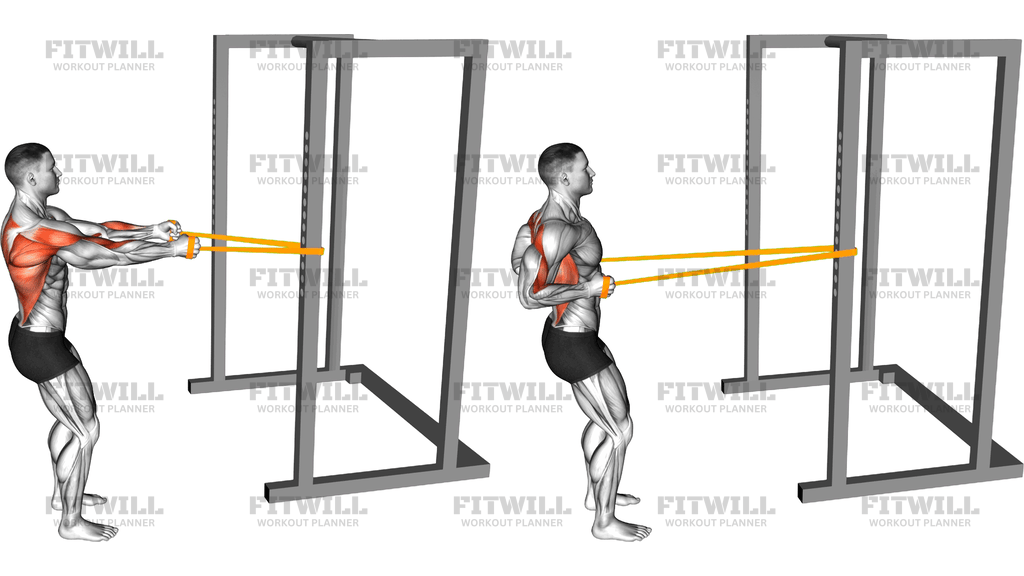
Instructions
- Loop a resistance band around a sturdy vertical anchor such as a rack upright at about chest height, and check that it sits flat and secure with no twists.
- Grip one end of the band in each hand with your palms facing each other or slightly inward, and walk back until your arms are fully extended and the band is already under light tension.
- Set your feet hip-width apart with a soft bend in the knees, and keep a tall, upright torso with your ribs stacked over your hips.
- Brace your core and pull your shoulder blades down and back before the rep begins, so your shoulders are not shrugged toward your ears.
- Exhale as you pull both hands straight back toward your lower ribs, driving your elbows past your sides and keeping them close to your body.
- At the end of the pull, squeeze your shoulder blades together and hold briefly with your hands just in front of your waist.
- Inhale as you slowly extend your arms forward, resisting the band's pull instead of letting it snap your hands back.
- Continue until your arms are fully straight and you feel a stretch across your upper back, without letting your shoulders roll forward.
- Reset your stance and brace, then begin the next rep from the fully extended position.
- Complete your reps, then step forward to release the band tension before letting go of the handles.
Tips & Tricks
- If you find yourself rocking your torso backward as you pull, step a little closer to the anchor so the band offers slightly less resistance and your trunk can stay vertical.
- Elbows drifting out to the sides turns this into a rear-shoulder fly rather than a row; keep them tracking back along your ribs.
- Shrugging at the top of each rep means the band load is too heavy or the pull is too short, so your upper traps take over from the rhomboids, so reduce the tension and focus on pulling the elbows low.
- Do not let the band rush your arms forward on the return; the eccentric portion is where a lot of the upper back work happens, so take two to three seconds to extend.
- Wrists that bend backward under tension reduce your pull strength and strain the forearms; keep the hands as a rigid extension of the forearm.
- Because the band gets harder the further you stretch it, keep the end-range pause short and controlled instead of holding a long max squeeze.
- If your anchor point sits higher than your chest, the band will pull your hands upward as you release, so either lower the anchor or finish each rep deliberately at rib height.
- Chalk or grippy gloves can help if the band ends slip out of sweaty hands, especially near the end of a set when grip fatigues.
- Check the band for small cracks or worn spots before each session; a band that snaps under full stretch is the main safety risk in this exercise.
Frequently Asked Questions
Which muscles does the Resistance Band Standing Row work?
It primarily trains the rhomboids and mid-traps of the upper back, with the lats, rear shoulders, and biceps assisting. Your core and legs work isometrically to keep you stable while standing.
Is the Resistance Band Standing Row good for beginners?
Yes. The band load is easy to adjust by stepping closer or farther from the anchor, and the standing position teaches body control without requiring a full gym setup.
How high should I anchor the band for the Resistance Band Standing Row?
Anchor it at about chest height so the band travels straight back toward your lower ribs. A higher anchor changes the pulling angle and shifts work toward the shoulders and traps.
Why does the Resistance Band Standing Row feel harder at the end of each rep?
Band resistance increases as the band stretches, so tension peaks when your hands are closest to your body. This is normal, and it is why the squeeze at the ribs is the most demanding part of the rep.
How far back should I stand from the anchor?
Stand far enough that the band is taut before your arms start moving, but not so far that you cannot complete the pull without leaning back. If form breaks down, step in slightly.
What is the most common mistake in the Resistance Band Standing Row?
Leaning the torso backward and shrugging the shoulders to help the band in. Both reduce upper back involvement, so keep the trunk tall and drive the elbows back instead.
Can I do the Resistance Band Standing Row if I do not have a rack?
Yes, as long as you have a sturdy anchor at chest height, such as a heavy piece of furniture, a door anchor, or a solid post. Always confirm the anchor cannot move or tip under tension.
How does the Resistance Band Standing Row compare to a seated cable row?
Both are horizontal pulls for the upper back, but the band's resistance rises through the range instead of staying constant, and the standing stance adds a balance and core stability demand.
How many reps and sets should I do of the Resistance Band Standing Row?
For general strength and posture work, 3 sets of 10 to 15 reps with a controlled return works well. Step closer for more reps or farther back for more tension.
Is it safe to release the band mid-set?
No. Step forward toward the anchor to let the tension come off first, then release your grip. Letting go while the band is stretched can send it snapping back toward you.