Band Reverse Wrist Curl
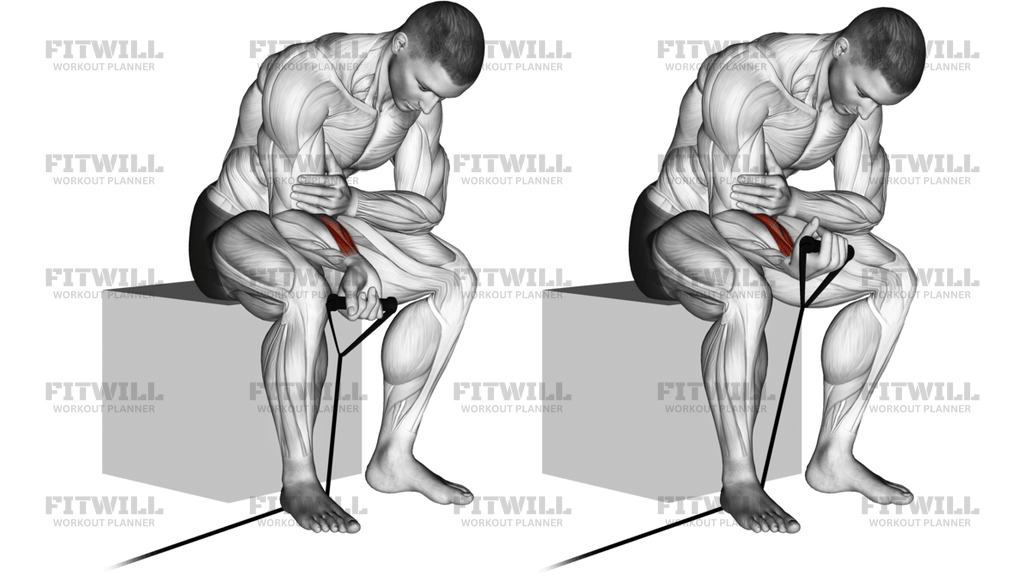
The Band Reverse Wrist Curl is a seated isolation exercise for the top of the forearm. You anchor a resistance band under your foot, hold the handle with an overhand grip, and rest your forearm along your thigh so the wrist hangs just past the knee. From there you extend the wrist upward against the band's downward pull, then lower it back down with control. The illustration shows a single-arm setup with the working forearm braced on the thigh and the band running from the foot on the floor up to the hand.
This movement targets the wrist extensors, the muscle group running along the outside of the forearm from just below the elbow down to the back of the hand. These muscles are responsible for pulling the back of the hand toward the top of the forearm, and they also stabilize the wrist during gripping actions. Because the band provides tension that increases as you extend the wrist, the hardest part of each rep lands right where the muscles are shortened, which is difficult to achieve with a dumbbell alone.
The reverse wrist curl is especially useful for people whose training or daily work loads the flexor side of the forearm heavily. Climbers, golfers, tennis players, and anyone who does a lot of pulling, typing, or gripping often develops strong forearm flexors while the extensors lag behind. Balancing that ratio helps support the elbow and wrist during heavy gripping work. It is also a common rehab-friendly choice after forearm or elbow issues, since the band offers smooth, joint-friendly resistance that is easy to scale.
Setup matters more here than with most arm exercises. Your forearm needs a firm, stable surface, which is why it rests along the thigh, and your wrist must be free to move through its full arc without the knee or the band's anchor point blocking it. Keep the band anchored securely under the middle of your foot; if it slips forward, resistance shifts and the movement becomes sloppy. Sit tall with feet flat on the floor rather than hunching over the working arm.
To execute it well, think of the hand as the only moving part. The elbow stays planted on the thigh, the forearm stays glued to the leg, and the wrist hinges up and down like a hinge joint, which is exactly what it is. Curl the back of the hand up toward the ceiling as far as your wrist comfortably allows, pause briefly at the top, then resist the band on the way down until the hand hangs slightly below neutral. Higher reps in the 12-20 range work well because the wrist extensors are small, endurance-oriented muscles, and lighter band tension done cleanly beats heavy tension done with swinging.
Keep the effort honest and the tempo slow. If you find your shoulder shrugging, your elbow drifting off the thigh, or your whole hand twisting, the band is too strong or your forearm has lost its support position. A slight stretch at the bottom and a deliberate squeeze at the top will do more for this muscle group than rushing through a big range with momentum.
[ Workout Log & Planner ]
Put your next workout in Fitwill
Keep your plan and training log ready when you are.


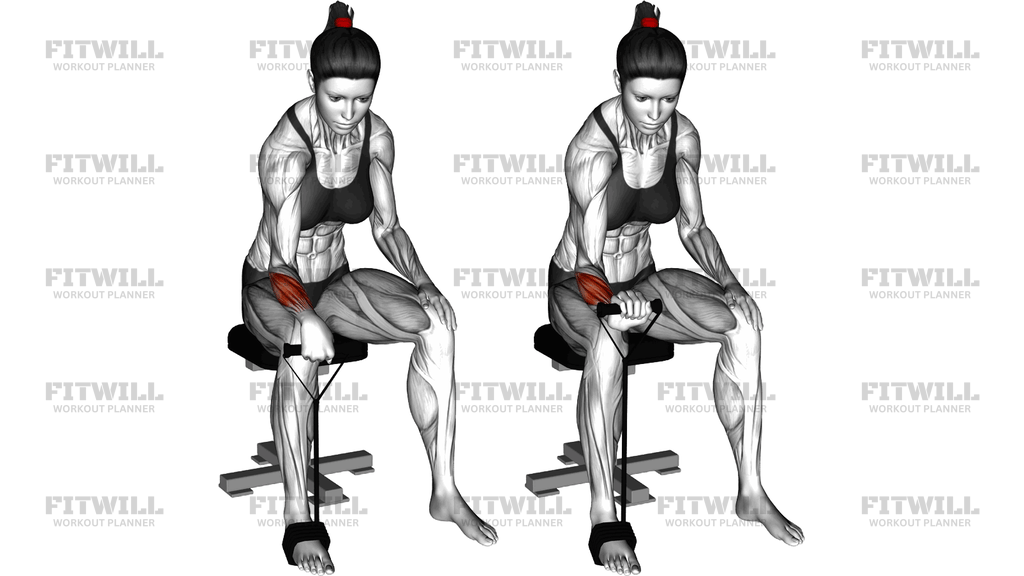
Instructions
- Sit on a bench with your feet flat on the floor and anchor one end of a resistance band securely under the middle of your working-side foot, with the band running up in front of your shin.
- Grip the handle at the other end of the band with an overhand grip, palm facing down, and place your working forearm along your thigh so the wrist hangs just past the knee.
- Let the hand hang down toward the floor at the start, with the band pulled taut and slight tension already on the wrist.
- Sit tall and brace your trunk lightly; rest your free hand on your opposite thigh for balance and keep your shoulders relaxed.
- Keeping the forearm pressed against your thigh, extend the wrist and pull the back of your hand up toward the ceiling against the band's resistance.
- Stop at the top of the range where your wrist is fully but comfortably extended, and hold that position for a brief pause.
- Lower the hand back down slowly, resisting the band's pull until the wrist flexes slightly below neutral and you feel a mild stretch along the top of the forearm.
- Exhale as you extend the wrist up, and inhale as you lower the hand back down.
- Complete all reps on one side, then re-anchor the band under the other foot and repeat with the opposite arm.
- Between sets, release the handle fully and check that the band is still seated securely under your foot before starting the next set.
Tips & Tricks
- The most common fault is letting the elbow slide off the thigh as the set gets hard; if the forearm loses contact with the leg, the shoulder and elbow start doing the work, so reset the arm position before continuing.
- Do not choose a band so heavy that you have to yank the hand up; the wrist extensors are small muscles, and a band that lets you perform 12-15 smooth reps is usually right.
- Watch for the hand rolling or twisting at the top of the rep, which shifts work away from the extensors; keep the knuckles facing the ceiling and the wrist moving in a straight hinge.
- If the band digs into your shin or drags across the knee, adjust your foot position or shorten the band so it runs straight from the foot to the handle.
- Control the bottom position instead of letting the band snap the hand down; the eccentric is where a lot of the forearm-building value sits in this exercise.
- Keep the fingers relaxed around the handle rather than death-gripping it, so the exercise trains the wrist extensors instead of turning into a grip contest.
- A brief pause at the top of each rep forces the shortening portion of the movement to work, since the band tension drops off if you rush through the top.
- If your wrist feels pinched at full extension, shorten the range slightly rather than pushing through discomfort; the top end of the range tends to improve as the muscles get stronger.
- Do the weaker or more affected arm first, and match the rep count on the stronger side rather than working to different effort levels.
Frequently Asked Questions
Which muscles does the Band Reverse Wrist Curl work?
It primarily targets the wrist extensors on the top of the forearm, including the extensor carpi radialis and extensor carpi ulnaris. The grip muscles work to hold the handle, but they are supporting players, not the focus.
Why is the reverse version done with the palm facing down?
The overhand, palm-down grip places the wrist extensors in line to lift the back of the hand against resistance. A palm-up grip would switch the work to the wrist flexors on the underside of the forearm, which is a different exercise.
Can beginners do the Band Reverse Wrist Curl?
Yes, and it is actually a good starting point for forearm training because band resistance is smooth and easy to adjust. Beginners should start with a light band, 12-15 reps, and focus on keeping the forearm fixed against the thigh.
Why is the forearm rested on the thigh during this exercise?
The thigh acts as a stable platform that removes the elbow and shoulder from the movement. Without that support, the arm tends to swing and the effort drifts away from the wrist joint, which is the only joint that should be moving.
Is the Band Reverse Wrist Curl helpful for forearm and elbow balance?
Many people train gripping and pulling heavily, which favors the flexor side of the forearm, while the extensors get little direct work. Adding reverse wrist curls helps balance the two sides, which supports the wrist and elbow during heavy gripping.
How is this different from a regular band wrist curl?
A regular wrist curl uses a palm-up grip and flexes the wrist toward the palm, training the forearm flexors. The reverse version flips the grip and the direction, so you extend the back of the hand up and train the extensors instead.
How many reps and sets should I do?
Because the wrist extensors are small endurance muscles, 2-3 sets of 12-20 controlled reps per side works well. Pick a band tension you can manage without the forearm lifting off your thigh.
What can I use instead of a handle on the band?
You can loop the band directly around your hand or hold the band itself if you do not have a handle attachment. Just make sure the anchor under your foot stays secure and the tension path stays straight from foot to hand.
Should I feel a stretch at the bottom of the movement?
A mild stretch along the top of the forearm when the hand dips below neutral is normal and useful. Sharp or pinching pain, especially at full extension, is a signal to shorten the range and reduce band tension.
Is it safe to train the wrists every day?
The forearm muscles recover fairly quickly, but they still benefit from rest, so 2-4 sessions per week is a sensible frequency. If the wrists feel sore from other training or work, reduce volume rather than pushing through daily.