Resistance Band Wrist Flexion
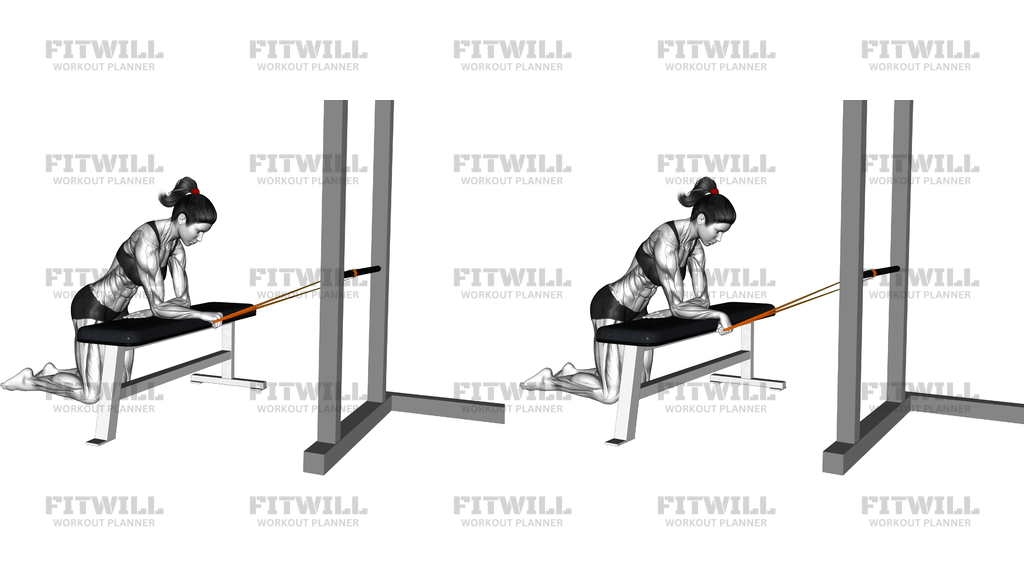
Resistance Band Wrist Flexion is a focused forearm exercise that trains the muscles on the underside of your forearm, mainly the wrist flexors, by curling the wrist upward against the pull of a band. In the standard setup you kneel beside a flat bench, rest your forearm along the padded surface with your wrist hanging just past the edge, and hold the band in your hand while the other end is anchored in front of you at roughly forearm height. The tension wants to pull your hand down and forward, so curling the palm toward the ceiling against it gives you a smooth, even resistance through the whole range.
This movement is a staple for anyone who needs a stronger, more resilient grip and wrist flexion. That includes lifters struggling to hold onto heavy bars during deadlifts, rows, or pull-ups, climbers who rely on forearm endurance, and racket-sport players whose wrists absorb constant loading. It is also commonly used in rehab-style settings because the band provides light, adjustable tension that is easy to scale, making it friendlier to cranky wrists than a heavy dumbbell would be.
The setup matters more than most people expect. Because your forearm is supported on the bench, the elbow stays fixed and the wrist is the only joint that moves, which is exactly what you want. If the forearm drifts off the bench or the elbow slides forward, you start borrowing movement from the shoulder and upper arm, and the wrist flexors stop doing the work. Kneeling in front of the bench with your torso leaning over it, as shown here, keeps everything stable and lets you focus purely on the wrist.
Execution is deliberately small. Start with the wrist bent downward so the band is stretched, then curl the hand up as high as the wrist allows, squeezing the underside of the forearm at the top. Lower the hand back down slowly rather than letting the band snap you into the stretched position. The range of motion is only a few inches, but that is normal and correct; the wrist is a small joint and the working muscles are small too.
A practical coaching note: treat this as a controlled, higher-rep exercise rather than a heavy grind. Forearm flexors tend to respond well to moderate loads performed for fifteen or more reps per set, and the band makes it simple to adjust tension by shortening or lengthening your grip on it or choosing a lighter band. Stop if you feel sharp pain at the wrist or inside of the elbow, and build volume gradually, since these tendons can get aggravated when the workload jumps too quickly.
[ Workout Log & Planner ]
Put your next workout in Fitwill
Keep your plan and training log ready when you are.


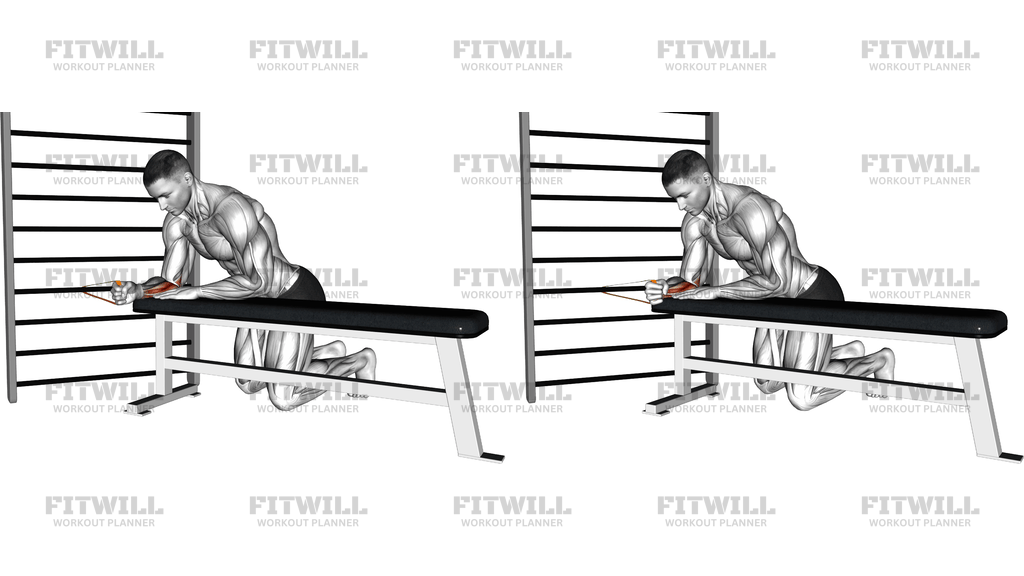
Instructions
- Anchor one end of the resistance band to a rack or sturdy object in front of you at roughly forearm height, then kneel beside a flat bench facing the anchor point.
- Rest your working forearm along the bench so it runs lengthwise on the pad, with your wrist hanging just past the edge and your palm facing up, and grip the free end of the band in that hand.
- Slide back or forward until the band is already taut at the starting position, and place your opposite forearm on the bench for support.
- Brace your trunk lightly and keep your torso draped over the bench so your shoulder, elbow, and wrist all stay in a fixed line.
- Begin with the wrist bent downward so the band is stretched behind your fingers and knuckles.
- Curl your hand upward by bending only at the wrist, pulling the band toward your forearm until your palm points up and the underside of your forearm is fully contracted.
- Pause for a beat at the top and squeeze the wrist flexors before lowering.
- Lower the hand back down in a slow, controlled motion until the wrist is bent down and the band is stretched again.
- Exhale as you curl the wrist up and inhale as you lower it back down.
- Complete all reps on one side, then re-grip the band with the other hand and repeat with the opposite forearm on the bench.
Tips & Tricks
- If the band loses tension at the bottom of the rep, you are not starting low enough; let the wrist bend fully down so the flexors get a real stretch before each curl.
- Do not lift your forearm off the bench to gain extra range; if you feel the elbow or shoulder moving, the load is too heavy or your wrist is fatigued.
- Grip the band with just enough finger tension to hold it; strangling the band turns the set into a grip exercise and steals work from the wrist flexors.
- Keep the movement small and clean; the wrist only travels a few inches, so big swinging reps mean the band is too strong.
- If your fingers tire before your forearm, wrap the band once around your hand or hold it with your fist closed instead of a finger-only grip.
- Slow the lowering phase to two or three seconds; letting the band snap the wrist down is the most common way to aggravate the inside of the elbow in this exercise.
- Experiment with moving your knees closer to or farther from the anchor point to dial in tension instead of jumping straight to a heavier band.
- Keep your neck relaxed and your gaze down at the bench; craning up while kneeling tightens the shoulders and makes long sets uncomfortable.
Frequently Asked Questions
Which muscles does Resistance Band Wrist Flexion work?
It primarily targets the wrist flexors on the underside of the forearm, including the flexor carpi radialis, flexor carpi ulnaris, and palmaris longus. Your grip and the smaller stabilizers around the hand and wrist assist throughout the set.
Why is the forearm supported on a bench for this exercise?
Supporting the forearm on the bench pins the elbow so the wrist is the only joint that moves. This isolates the wrist flexors and prevents you from cheating with the shoulder or upper arm.
Is Resistance Band Wrist Flexion suitable for beginners?
Yes, it is one of the more beginner-friendly forearm exercises because the band tension is light and easy to adjust. Start with a thin band and higher reps, and keep the reps smooth rather than heavy.
How many reps should I do for Resistance Band Wrist Flexion?
Most people get the best results with 12 to 20 reps per set for two to four sets per side. The wrist flexors are small endurance-oriented muscles, so moderate tension and controlled reps work better than heavy loads.
Can I do this exercise without a bench?
Yes, you can rest your forearm on your thigh while seated, or support it on the edge of a sturdy table. The key requirement is that the forearm sits flat and the wrist can hang freely past the edge.
My elbow hurts on the inside during this exercise. What should I change?
That is often a sign the band tension is too high or you are letting the band yank your wrist down at the bottom. Use a lighter band, slow the lowering phase, and reduce your sets for a while before building back up.
How does the band version differ from a dumbbell wrist curl?
The band provides resistance that peaks when the band is stretched, while a dumbbell pulls down evenly through the whole range. The band is generally gentler on the wrist joint and easier to fine-tune, which makes it a good choice for higher-rep or rehab-style work.
Should my palm face up or down during Resistance Band Wrist Flexion?
Your palm should face up, since palm-up wrist curling is what loads the wrist flexors. If your palm faces down, you are working the opposite muscles, the wrist extensors, which is a different exercise.
How do I adjust the difficulty of Resistance Band Wrist Flexion?
Use a thicker band, move your kneeling position closer to the anchor to pre-stretch the band more, or shorten your grip on it. To make it easier, use a lighter band or sit farther back so there is less tension at the start.