Resistance Band Seated Wide Row
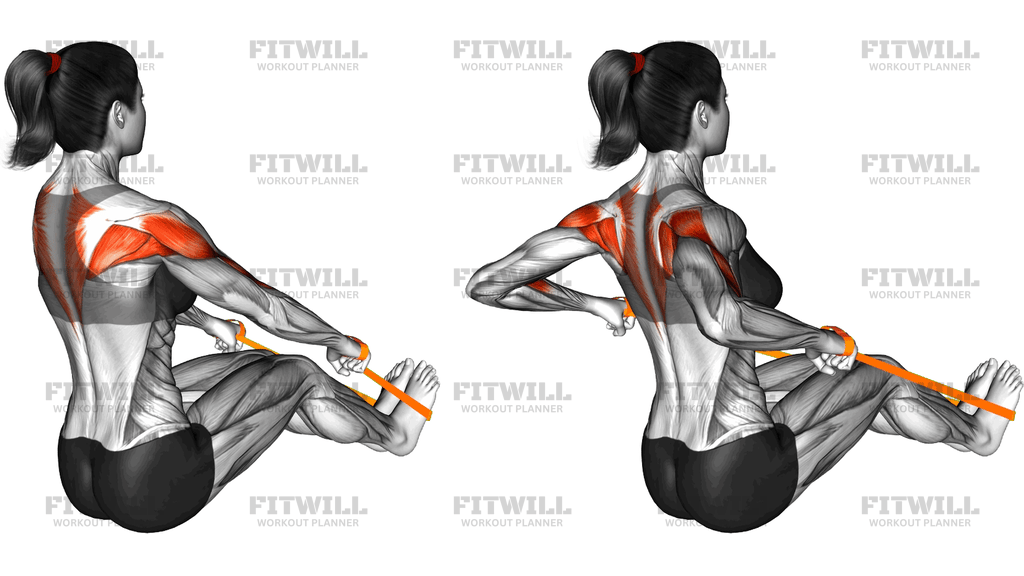
The Resistance Band Seated Wide Row is a floor-based rowing exercise that uses a single resistance band looped around both feet while you sit tall with your legs extended. Unlike a close-grip seated row, the wide grip places your hands toward the outer edges of the band so your elbows travel up and out to your sides as you pull. This elbow path shifts the emphasis onto the upper back—especially the rhomboids and mid traps—along with the rear shoulders, while the biceps assist on every pull.
This is one of the most accessible ways to train the muscles between your shoulder blades. It works well for people who train at home with minimal equipment, for beginners learning what a proper row should feel like before touching heavier gym equipment, and for anyone who spends long hours at a desk and needs more pulling volume to balance out rounded, forward-rolled shoulders. Because the band's resistance is elastic, the pull gets harder as the band stretches, which challenges the back most in the fully contracted position.
Setup matters more here than in most rowing variations. The band must be secured flat against the soles of both feet with a loop around each hand, and your grip width on the band determines everything about the movement. Sit too close and the band will be slack at the start; sit too far away and your lower back will round as your hamstrings pull your torso forward. Your torso should stay upright throughout, with only a slight backward lean as you pull.
To perform the row, drive your elbows back and out toward your hips at roughly chest height, squeezing your shoulder blades together at the end of the pull. Keep your wrists neutral and avoid shrugging your shoulders up toward your ears. Return the band forward under control, letting your arms extend fully while your torso resists being dragged forward by the band's tension.
The wide row pairs naturally with pressing and core work in a home routine, and it makes a good warm-up activation drill before heavier barbell or cable rows. Common mistakes to watch for are shrugging the traps, pulling with bent wrists, letting the torso collapse into a slouch at the start, and snapping the arms back instead of returning slowly. Choose a band tension that lets you complete all reps with your chest tall and elbows finishing behind your torso line.
[ Workout Log & Planner ]
Put your next workout in Fitwill
Keep your plan and training log ready when you are.


Instructions
- Sit on the floor with your legs extended in front of you and your knees slightly bent, feet flexed and about hip-width apart.
- Loop a resistance band around the soles of both feet so it sits flat against each foot, then wrap one end around each hand.
- Slide your hands outward along the band to a wide grip, wider than shoulder width, so there is light tension in the band with your arms extended.
- Sit tall from your sit bones, brace your core lightly, and lift your chest so your spine is neutral and your shoulders are relaxed away from your ears.
- Exhale and pull the band toward your lower chest by driving your elbows back and out to the sides, keeping them above forearm height.
- At the end of the pull, squeeze your shoulder blades together and down, with your hands near your ribs and wrists straight.
- Pause for a beat in the contracted position, feeling the squeeze across your upper back.
- Inhale and slowly let the band pull your arms forward, extending fully while keeping your chest lifted and resisting any forward rounding of your spine.
- Complete all reps on one band tension, then release the band from your hands before letting go of the loop at your feet to avoid the band snapping back.
Tips & Tricks
- If your torso gets dragged forward at the start of each rep, the band is too strong—switch to a lighter band or shorten your sitting distance so the stretch feels moderate, not maximal.
- Wide rowing pulls the elbows high, so if you feel it mainly in your biceps, think about leading with your elbows and keeping your hands relaxed on the band instead of strangling it.
- Shrugging at the top of the pull means your upper traps are taking over; consciously press your shoulders down and back before each rep begins.
- Bent or cocked wrists are common when gripping a band under tension; keep the band running straight across your palm with your wrist in line with your forearm.
- Do not let your lower back round toward your feet at full arm extension—if tight hamstrings pull you into a slouch, bend your knees more or sit on a folded mat or low step to raise your hips.
- A half-second pause with the shoulder blades squeezed is what separates this from mindless band tugging; the upper back grows from that held contraction, not from band speed.
- Because band tension peaks when the band is longest, the easiest part is the start—use the extended position to reset your posture rather than rushing into the next rep.
- Avoid letting the band slide off the arch of your foot mid-set; flex your toes toward your shins so the band stays anchored flat across both soles.
Frequently Asked Questions
Which muscles does the Resistance Band Seated Wide Row work?
The primary work comes from the rhomboids and middle traps in the upper back, with strong help from the rear shoulders as the elbows travel out wide. The biceps and forearms assist with the pull, and the lats contribute less than they would in a close-grip row.
Why is the grip wider than in a regular seated band row?
The wide grip forces your elbows out to the sides instead of tucked against your ribs, which rotates the emphasis from the lats toward the rhomboids, mid traps, and rear delts. It is essentially the band version of a wide-grip cable row.
Is the Resistance Band Seated Wide Row suitable for beginners?
Yes, it is one of the safest ways to learn horizontal rowing because the band provides smooth resistance and no spinal loading. Start with a light band and focus entirely on sitting tall and squeezing the shoulder blades before progressing tension.
How do I set the correct distance from my feet?
Sit far enough that the band has noticeable tension with your arms fully extended, but not so far that your back rounds forward to reach. If you cannot sit upright at full extension, move closer or use a lighter band.
Should my legs be straight or bent during the Resistance Band Seated Wide Row?
Legs stay extended with a soft, slightly bent knee. Bending the knees more is a legitimate adjustment if tight hamstrings pull your lower back into a rounded position at the start of each rep.
My shoulders creep up toward my ears when I pull—how do I fix that?
That is upper trap compensation. Before each rep, pull your shoulders down and back, then initiate the row by thinking about driving your elbows toward your back pockets rather than lifting your hands.
What can I use instead if I do not have a resistance band?
A cable machine with a wide-grip handle attachment gives the same wide elbow path while seated, or you can perform a wide-grip dumbbell row lying chest-down on an incline bench. A light barbell bent-over row with a wide grip is another option.
How many reps and sets should I do?
For general upper back strength and posture work, 3 sets of 10 to 15 reps works well, since band resistance is easier to accumulate at higher volumes. Rest about 45 to 60 seconds between sets.
Is it safe to loop the band around my feet?
Yes, as long as the band sits flat across the soles with your toes flexed to hold it in place. Always keep tension controlled and release the band from your hands first when finishing a set so it cannot snap back toward your face.
How is the Resistance Band Seated Wide Row different from a close-grip seated row?
The close-grip version keeps elbows low and near your sides, biasing the lats, while the wide row raises the elbows and targets the upper back between the shoulder blades. Alternating both in your program covers the back more completely.