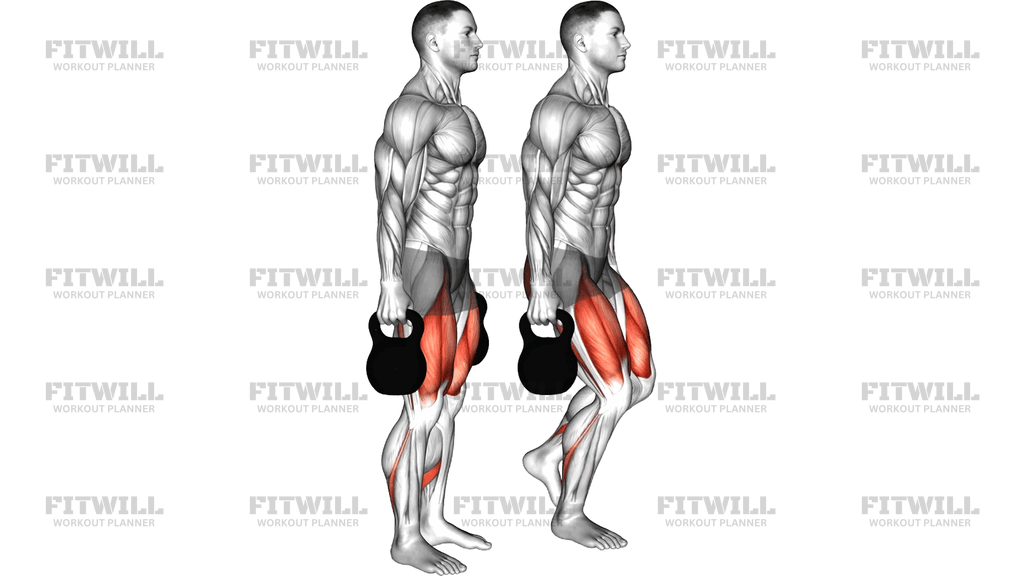
Kettlebell Standing Calf Raise
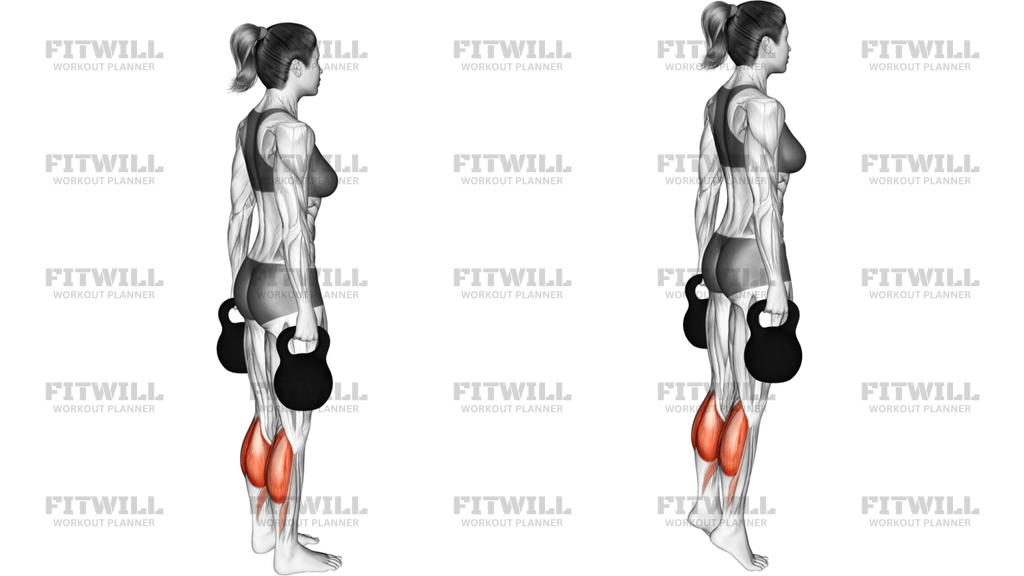
Kettlebell Standing Calf Raise is a standing lower-leg exercise that loads the calves while your body stays upright and balanced. Holding kettlebells at your sides gives you a simple, direct load without putting a bar across your back, so the work stays focused on ankle extension and calf tension. The floor version shown here keeps the setup straightforward and makes it easy to repeat clean reps with the same stance and range.
The main training effect comes from the gastrocnemius and soleus, with the feet, ankles, and lower-leg stabilizers helping keep the arches and knees organized. Because the load hangs beside the body, the torso should stay quiet while the ankles do the moving. If you start leaning, bouncing, or shifting weight to one side, the calves lose tension and the set turns into momentum work.
A good rep begins with a tall stance, feet about hip-width apart, and pressure centered over the balls of the feet. From there, rise straight up onto the toes as high as you can without rocking the hips or shrugging the shoulders, then pause briefly at the top. Lower slowly until the heels return to the floor and you feel a clear stretch through the calves, then reset before the next rep.
This exercise fits well as accessory calf work, ankle-strength work, or a simple finisher after leg training. It is also useful when you want an easy-to-learn loaded movement that still rewards strict tempo and control. Beginners can usually handle it well with light kettlebells, while more advanced lifters can progress by adding single-leg work, slower lowers, or longer pauses instead of simply chasing heavier bells.
[ Workout Log & Planner ]
Put your next workout in Fitwill
Keep your plan and training log ready when you are.


Instructions
- Stand tall with a kettlebell in each hand, arms straight, feet about hip-width apart, and toes pointed forward or only slightly out.
- Let the kettlebells hang by your sides and keep your weight evenly spread across both feet.
- Lift your chest, keep your shoulders down, and set a light brace so your torso stays quiet.
- Press through the balls of your feet and raise both heels straight up as high as you can without leaning back.
- Keep your ankles lined up over the second toes and let the calves do the work instead of rocking through the hips.
- Pause for a brief squeeze at the top with full control.
- Lower the heels slowly until they touch the floor again and the calves lengthen under tension.
- Reset your balance before the next rep and repeat without bouncing.
Tips & Tricks
- Keep the knees straight but not jammed back; excessive knee bend turns the movement into a different lower-body pattern.
- Stay centered over the big toe and second toe instead of letting the feet roll to the outside edges.
- Hold the kettlebells still. If the bells swing, the calves lose tension and the torso starts cheating.
- Use a slow lowering phase of about two to three seconds to build more calf work without needing heavier bells.
- Pause at the top long enough to feel the calves contract, but do not bounce out of the bottom.
- Pick a load that lets you reach the same heel height on every rep; uneven reps usually mean the bells are too heavy.
- Keep the shoulders down so the weight stays in the hands and does not creep into a shrug.
- This floor version has a shorter range than a step, so earn the strict version before adding instability or extra depth.
Frequently Asked Questions
What muscles does Kettlebell Standing Calf Raise train?
It mainly trains the gastrocnemius and soleus, with the feet and ankles working to keep you balanced.
Why are the kettlebells held at my sides?
The side carry keeps the torso upright and leaves the calves to do the lifting without a bar on your back.
Should my knees stay locked during the raise?
Keep them straight but not aggressively locked out. A tiny softness is fine as long as the movement stays in the ankles.
Can I do this as a single-leg calf raise instead?
Yes. Single-leg reps make the exercise much harder and are a good progression once the two-leg version is stable.
Do I need to stand on a step for this exercise?
No. The floor version shown here is a clean starting point. A step can add more stretch later if you can control it.
How high should I rise on each rep?
Rise as high as you can while keeping the torso still and the pressure centered over the forefoot.
Why do my feet cramp or wobble during the set?
That usually means the load is too heavy or the pressure has shifted to the outside of the feet. Lighten the bells and keep the tripod of the foot stable.
How do I make the exercise harder without adding much weight?
Slow the lowering phase, add a pause at the top, or move to single-leg reps once the bilateral version is clean.