Downward Punch
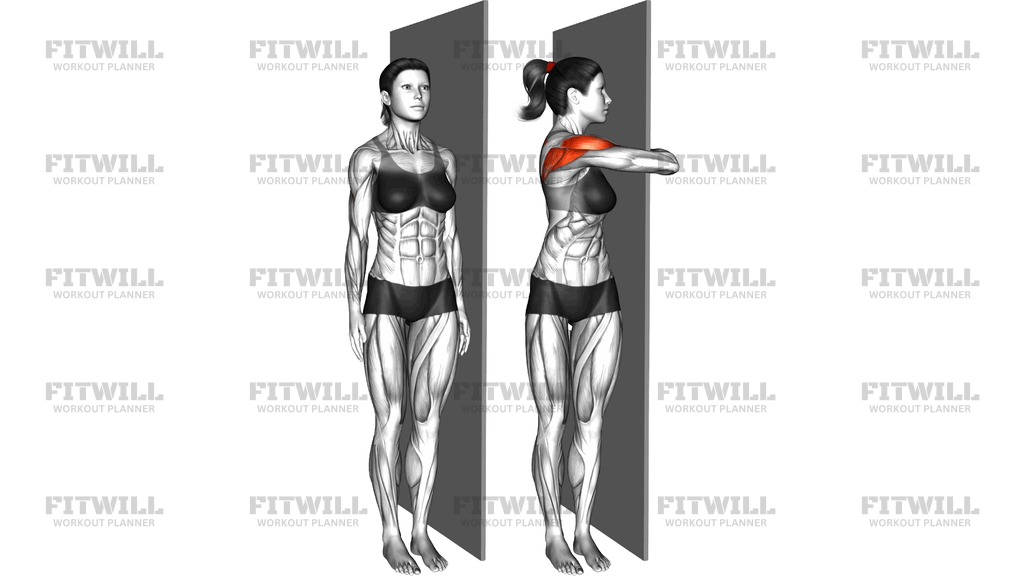
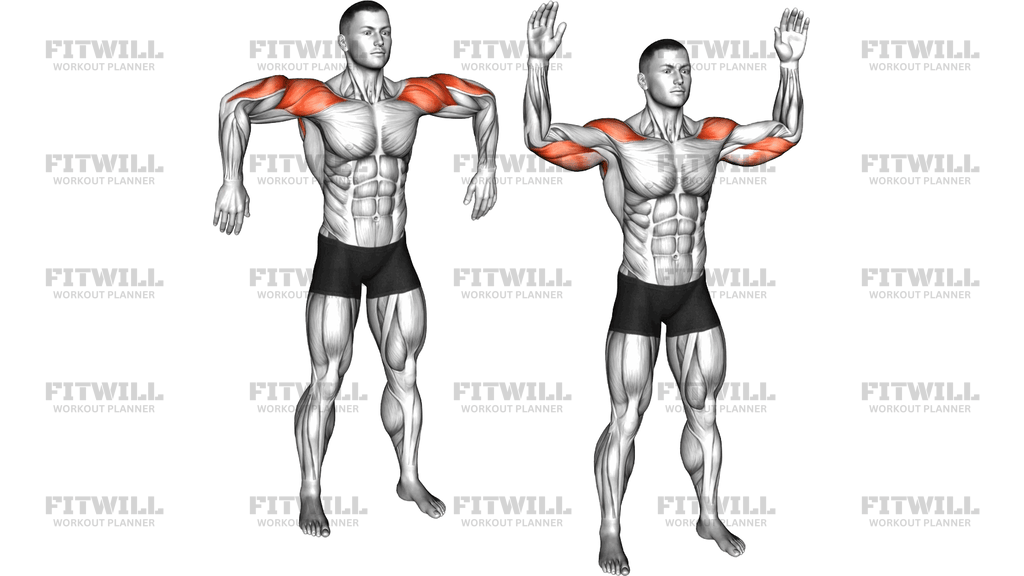
The Downward Punch is a standing bodyweight shoulder exercise that looks simple but demands real control from your deltoids and the small stabilizing muscles around the shoulder joint. You set your upper arms out to the sides at shoulder height with elbows bent to ninety degrees, then rotate your forearms from the hands-up position down toward the floor, as if driving two punches straight down at your sides, before rotating back up. The elbow stays fixed in place the entire time, which forces the rotation to come from the shoulder itself rather than from swinging the arms.
This movement earns its place in a routine because it trains the side delts and rotator cuff through a rotation pattern that most pressing and raising exercises never touch. Bench presses, overhead presses, and lateral raises move the arm as a unit; the Downward Punch isolates rotation with the arm already abducted, which is one of the more demanding positions for the rotator cuff to control. That makes it useful for anyone who wants durable, well-coordinated shoulders, not just bigger ones.
It fits naturally into warm-ups before pressing days, into rehabilitation-style shoulder care programs, and into the tail end of a shoulder workout as a controlled finisher. Because there is no external load, the exercise is accessible to beginners, yet the position is humbling even for experienced lifters who discover their rotation control is weaker than their press strength. Office workers and overhead athletes alike benefit from keeping this rotational range smooth and pain-free.
Setup matters more than speed here. Stand tall with feet about hip-width apart, ribs stacked over the pelvis, and shoulders pulled gently back and down. If you let your upper arms drift forward or your chest collapse, the elbow rises and the shoulder joint rolls forward, and you lose the clean rotation the exercise is meant to train. Keep the upper arm parallel to the floor throughout, like a shelf that does not tilt.
To execute well, think of the elbow as a hinge pinned in space. From the goalpost position with palms facing forward, sweep the forearms down in a smooth arc until your hands point toward the floor, then reverse the path back up without letting the elbows drop or the shoulders shrug toward your ears. The tempo should be slow enough that you could pause at any point in the arc. Breathe steadily, exhaling as the hands travel down and inhaling on the way up.
The most common fault is turning the drill into a sloppy arm swing: elbows dropping toward the ribs, wrists flopping, or the torso leaning to help the hands along. If the full arc feels impossible, shorten the range and rotate only partway down until control improves. Mild muscular effort is the goal; any sharp pinching at the front or top of the shoulder is a signal to reduce the range or stop and reassess your posture before continuing.
[ Workout Log & Planner ]
Put your next workout in Fitwill
Keep your plan and training log ready when you are.


Instructions
- Stand upright with your feet hip-width apart and your weight balanced evenly across both feet.
- Raise your upper arms out to the sides until they are parallel to the floor, and bend your elbows to ninety degrees so your forearms point straight up with palms facing forward.
- Draw your shoulder blades gently back and down, brace your core lightly, and keep your ribcage stacked over your hips.
- Keeping your elbows fixed at shoulder height, rotate your forearms forward and down in a smooth arc until your hands point toward the floor, as if punching downward at your sides.
- Pause briefly at the bottom of the arc with the forearms fully rotated down.
- Reverse the rotation and bring the forearms back up to the vertical starting position without letting the elbows drop or drift forward.
- Exhale as the hands travel down and inhale as they return up, keeping the breath steady throughout the set.
- Complete your repetitions with a tempo slow enough that the elbows never wobble, then lower your arms and shake out the shoulders between sets.
Tips & Tricks
- Pin your elbows in place by imagining they are resting on two invisible shelves; if the elbows sink toward your ribs mid-rep, the rotation is coming from the wrong place.
- If your wrists bend or flop during the arc, make loose fists and think about punching with the forearm as one solid lever.
- A common mistake is shrugging the shoulders toward the ears as fatigue builds; drop the traps back down before continuing rather than grinding through a tense rep.
- Do not let the chest lean backward to help the hands travel; the torso should stay vertical from the first rep to the last.
- Half the arc done with control beats a full arc done with momentum, so cut the range before you cut the quality.
- If the front of the shoulder pinches at the top position, start with the forearms angled slightly forward instead of perfectly vertical and build up from there.
- Use this as a warm-up drill before overhead pressing to wake up the rotator cuff, or as a finisher after lateral raises when the delts are already warm.
- Three to four controlled sets of eight to twelve slow rotations is plenty; this exercise rewards precision, not volume.
- Check yourself in a mirror from the front: the elbows should trace a straight horizontal line at shoulder height for every repetition.
Frequently Asked Questions
Which muscles does the Downward Punch work?
The side delts do most of the visible work holding the upper arms at shoulder height, while the rotator cuff controls the rotation of the forearms. The traps and upper back work isometrically to keep the shoulders from shrugging or rounding forward.
Is the Downward Punch a strength exercise or a warm-up?
It works as both. With no load and a controlled arc, it is an excellent warm-up before pressing, and it also serves as a demanding burnout finisher at the end of a shoulder session.
Why do my elbows drop when I punch downward?
Dropping elbows usually means the rotator cuff and rear shoulder muscles lack the control to rotate the arm while it is held at shoulder height. Shorten the range so the elbows stay level, and gradually extend the arc as control improves.
How many reps of the Downward Punch should I do?
Eight to twelve slow, controlled rotations per set works well for most people. Because the muscles involved are small and endurance-oriented, prioritize smooth tempo over high rep counts.
Can beginners do the Downward Punch safely?
Yes, it is bodyweight-only and easily scaled by reducing the rotation range. Beginners should start with half arcs and stop if they feel any sharp pinching at the shoulder.
What is the difference between the Downward Punch and a lateral raise?
A lateral raise lifts the whole arm against gravity, while the Downward Punch holds the upper arm static at shoulder height and rotates only the forearm. They train overlapping but distinct roles of the shoulder musculature.
Can I add weight to the Downward Punch?
It is best learned and practiced with bodyweight only. If it feels too easy, slow the tempo and add pauses in the arc rather than grabbing dumbbells, which tends to pull the elbows out of position.
What should I do if the rotation feels stiff or uncomfortable?
Reduce the arc to a range that feels smooth, check that your shoulders are relaxed and pulled back rather than hunched, and avoid forcing the end range. Persistent discomfort during this pattern is worth having assessed before loading the shoulder with heavier pressing.
Should the palms face forward or stay neutral during the punch?
Start from the goalpost position with palms facing forward, then let the hands rotate naturally as the forearms sweep down. The hand orientation follows the shoulder rotation; it should not be forced independently at the wrist.