V Sit Against Wall
The V Sit Against Wall is an isometric core and hip flexor hold performed on the floor with your entire back flat against a wall. From there, you lift your feet off the ground, extend your legs forward into a V shape, and hold that position with your hands planted beside your hips for balance. The wall takes care of your torso angle, so all the effort goes into keeping your legs elevated and your trunk solid instead of into fighting to stay upright.
This drill is popular with gymnasts, calisthenics athletes, martial artists, and anyone building toward L-sits, V-ups, or hanging leg raises. It trains the hip flexors and lower abs in a lengthened, demanding position, while the quadriceps work hard to keep the knees locked out. Because your back is supported, it is also a useful teaching tool for learning what a braced, neutral trunk feels like before moving to unsupported variations.
The wall setup matters more than it looks. With your head, shoulders, and lower back in contact with the wall, you remove the tendency to slump or hunch forward as fatigue sets in, which is the most common breakdown in seated core holds. It also gives you honest feedback: if your back peels off the wall mid-hold, you know the position has failed and it is time to end the set.
Execution is about patience rather than speed. Sit down, press your back into the wall, plant your hands, and lift your legs with the knees tucked first. Extend the legs out only as far as you can hold them up with control, then keep them there. If full extension is too much, a bent-knee tuck hold is a completely legitimate version of the same exercise.
Practically, this movement fits well at the end of a core session for one to three timed sets, or as a skill progression block two to three times per week when working toward an L-sit or V-sit on the floor or parallel bars. Stop the set when your back leaves the wall or your legs start dropping — quality of position beats duration every time.
[ Workout Log & Planner ]
Put your next workout in Fitwill
Keep your plan and training log ready when you are.


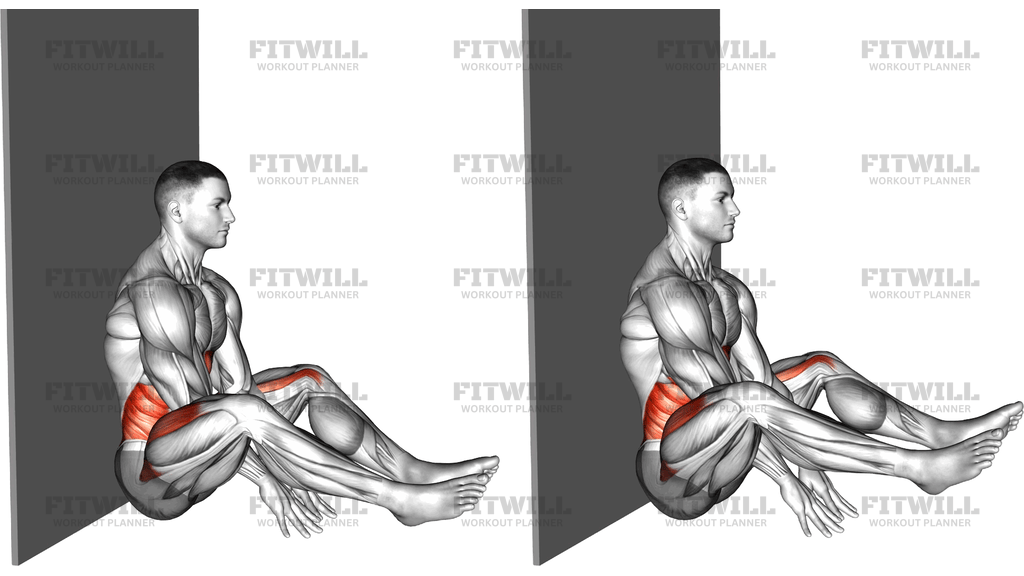
Instructions
- Sit on the floor facing away from a clear wall, then scoot your hips close so your head, shoulders, and lower back can all rest flat against it.
- Place your palms flat on the floor beside your hips, fingers pointing forward, with your arms mostly straight to act as support.
- Draw your ribs down and gently brace your stomach, keeping your entire back in contact with the wall before your feet leave the ground.
- Lift both feet off the floor and draw your knees toward your chest until your shins are roughly parallel to the floor.
- Slowly extend your knees and slide your legs forward and slightly apart until they form a V shape, keeping the toes pulled back and the knees locked out as much as you can.
- Hold the position with your legs as high off the floor as you can maintain, squeezing your thighs and keeping your back glued to the wall.
- Breathe steadily throughout the hold — short inhales through the nose and controlled exhales — rather than holding your breath.
- To finish, bend your knees back toward your chest and lower your feet to the floor under control instead of letting them drop.
- Rest, shake out your hip flexors, and reset your back position fully against the wall before starting the next hold.
Tips & Tricks
- If your lower back peels off the wall, your legs are extended too far out — pull the knees in slightly and keep the hold honest.
- Press your fingertips into the floor to stop yourself from sliding forward, which is a common issue on smooth floors.
- Hip flexor cramping is normal early on; shorten the hold to 10-15 seconds and stretch the hip flexors between sets.
- Point your toes toward your shins rather than letting the feet flop — it helps lock out the knees and engages the quads.
- Do not let your shoulders shrug up around your ears; keep them pressed back into the wall and your neck relaxed.
- Progress by extending the hold time first, then by straightening the legs further, not by jumping straight to the hardest version.
- Warm up with a few seated knee tucks or slow leg lifts so the hip flexors are ready for the extended position.
- If you cannot lift both legs at all yet, practice one leg at a time against the wall before combining them.
Frequently Asked Questions
What muscles does the V Sit Against Wall work?
The main work is done by the hip flexors lifting and holding the legs, with the lower abs and deep core stabilizing the trunk. The quadriceps stay active to keep the knees extended throughout the hold.
Why is this V Sit done against a wall instead of free-floating?
The wall supports your head, shoulders, and lower back, so you cannot slump forward as you tire. That lets you focus entirely on holding the legs up and keeps your trunk position honest.
Is the V Sit Against Wall suitable for beginners?
Yes, because it can be scaled easily — keep the knees bent in a tucked position instead of extending the legs into a full V. Start with short holds of 10-15 seconds and extend them as control improves.
How long should I hold the V Sit Against Wall?
Aim for 10-30 seconds per set for 2-4 sets, ending the set as soon as your back leaves the wall or your legs start sinking. Multiple quality short holds beat one long, sloppy one.
My hip flexors cramp during the V Sit Against Wall — what should I do?
Cramping usually means the position is too demanding for your current hip flexor strength. Bend the knees more, shorten the holds, and stretch the front of the hips between sets.
What is the most common mistake in this exercise?
Letting the lower back peel away from the wall as the legs extend, which shifts stress away from the core. Extend the legs only as far as you can while keeping your whole back in contact with the wall.
Can the V Sit Against Wall help me get a full L-sit or V-sit?
Yes, it is a common progression because it trains the same hip flexor and lower ab strength with the trunk supported. Once you can hold a solid extended position here, moving to floor or parallel bar versions becomes much more achievable.
Should my hands be doing any of the work?
The hands are for balance and to stop you sliding forward — press your fingertips lightly into the floor. Avoid pushing down hard enough to lift your hips off the ground, as that takes work away from the target muscles.
Is it safe for people with lower back issues?
The wall support makes this gentler than many seated core holds, but the raised legs still load the front of the hips and lower spine. If you have a history of back problems, keep the knees bent, use short holds, and stop if you feel any strain.