Elbow Touch To Outer Throw
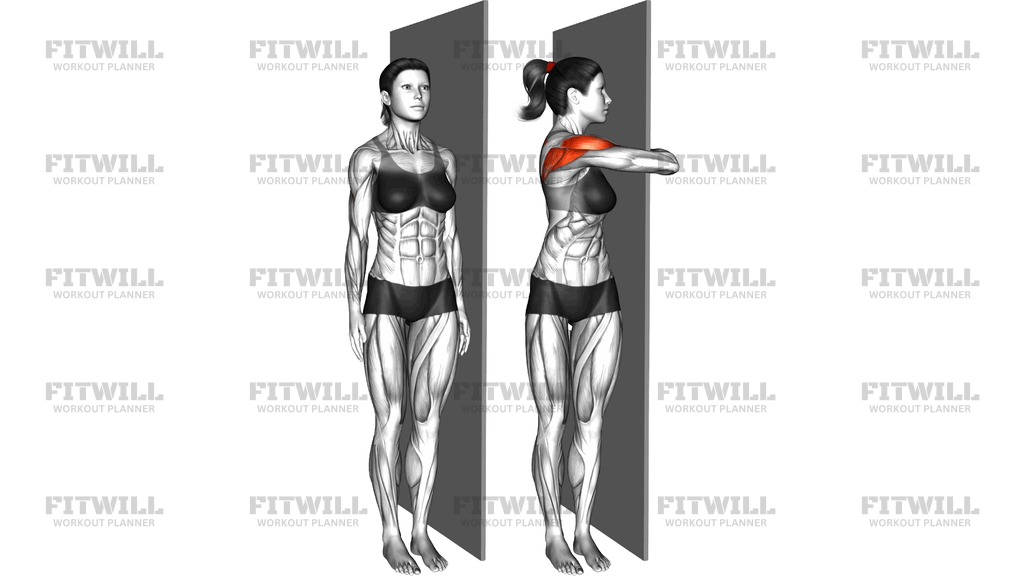
Elbow Touch To Outer Throw is a standing, body-weight movement that pairs a compressed arm position with an open, expansive one. You start by crossing your forearms in front of your chest so each hand touches the opposite elbow, then sweep the arms out and up in one continuous arc until they finish overhead in a wide V. The drill takes almost no space and no equipment, which makes it a go-to warm-up or activation exercise before pressing, throwing, or any upper-body session.
The value of the movement comes from the contrast between its two positions. The crossed-elbow start gently closes the arms across the chest and rounds the upper back slightly, then the outer throw opens the chest, stretches the front of the shoulders, and draws the shoulder blades down and together as the arms rise. Moving between those extremes takes the shoulders through a wide, controlled arc and wakes up the deltoids, the pectorals, and the muscles that control the scapula.
This exercise suits a wide range of people. Beginners can use it to learn what smooth, pain-free shoulder elevation feels like before they ever pick up a weight. Lifters use it as a primer before overhead presses, lateral raises, or bench work. Anyone who spends long hours sitting at a desk will feel it open up a slouched chest posture, and older trainees often appreciate how it maintains shoulder mobility without load.
Setup matters more than it looks. Stand tall with feet about hip-width apart, ribs stacked over the pelvis, and the core lightly braced so the torso does not lean or arch as the arms travel. Because the arms swing through a large arc, any sway in the trunk or shrugging of the shoulders steals work from the intended muscles and can pinch the shoulder joint at the top.
To execute it well, think of the throw as a sweep, not a jerk. The arms should accelerate smoothly from the crossed position, separate at chest height, and decelerate as they reach the overhead V with elbows soft. Pause briefly at the top, then bring the arms back down with the same control and re-cross to the starting touch. The return is where many people rush, so treat the downward-and-inward path as half the exercise.
Keep the neck relaxed and the breathing steady: exhale on the throw, inhale as the arms come back in. If you feel pinching at the front of the shoulder, narrow the overhead arc slightly rather than forcing a full V, and avoid letting the lower back arch to chase extra height. Ten to fifteen smooth repetitions is usually enough as a warm-up; the goal is quality of motion, not fatigue.
[ Workout Log & Planner ]
Put your next workout in Fitwill
Keep your plan and training log ready when you are.


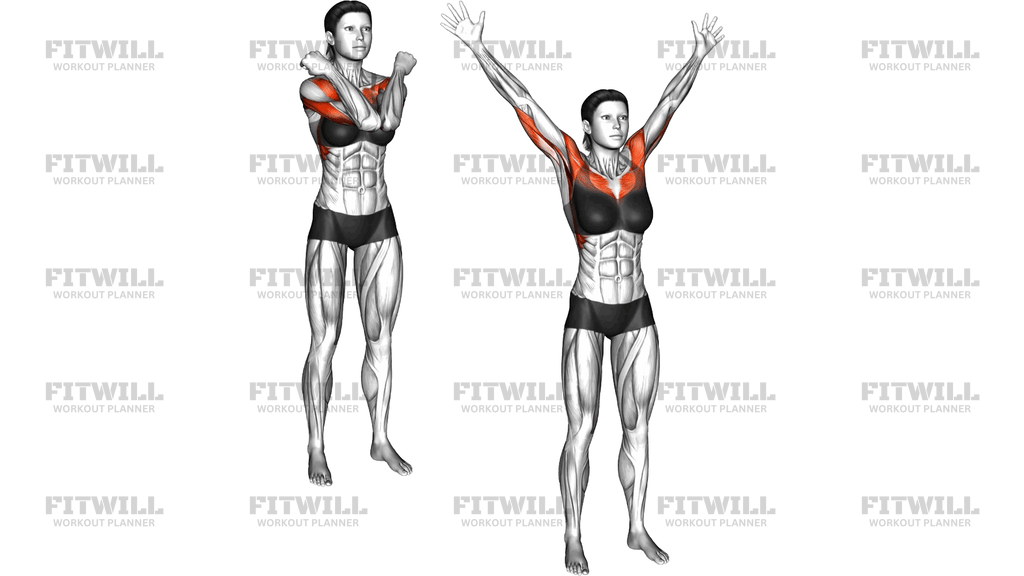
Instructions
- Stand upright with your feet hip-width apart, weight balanced across both feet, and your arms hanging relaxed at your sides.
- Raise both forearms and cross them in front of your chest so each hand touches the opposite elbow, keeping the shoulders relaxed and down.
- Brace the core lightly and keep the ribs stacked over the pelvis so the torso stays tall throughout the movement.
- Inhale, then sweep both arms out to the sides and upward in one smooth arc, letting them separate as they pass chest height.
- Finish with the arms overhead in a wide V, palms facing forward or slightly inward, elbows soft rather than locked.
- Pause briefly at the top with the shoulder blades drawn gently down and together, feeling the chest open.
- Exhale and reverse the path with control, drawing the arms down and back in until the hands touch the opposite elbows again.
- Keep the neck and jaw relaxed the entire time, avoiding any shrug toward the ears as the arms rise.
- Reset your stance if you drifted or swayed, then repeat for 10-15 controlled repetitions.
Tips & Tricks
- The most common mistake is jerking the arms overhead from the crossed position; the throw should be a continuous sweep, not two separate motions glued together.
- If your shoulders creep toward your ears at the top, deliberately reach the arms slightly wider instead of higher, which lets the upper traps stay quiet.
- Do not let the lower back arch to gain overhead range. If the ribs flare up, you are compensating for limited shoulder mobility rather than solving it.
- Keep the touch of each hand to the opposite elbow deliberate at the bottom, since a sloppy start position shortens the arc and reduces the chest opening at the top.
- Slightly bent elbows protect the joint during the sweep; straightening them hard at the top turns the movement into a lockout rather than a controlled arc.
- Match the speed to your breathing: one full breath per repetition keeps the rhythm smooth and stops you from rushing the set.
- If the front of the shoulder pinches during the throw, reduce the width of the overhead V a little; the arc should feel open, not compressed.
- Perform the movement in front of a mirror occasionally so you can spot trunk sway or leaning, which is easy to miss from the inside.
- Use it before pressing or pulling work rather than after heavy lifting, when the shoulders are cold and the drill has the most warm-up value.
Frequently Asked Questions
What muscles does the Elbow Touch To Outer Throw work?
It primarily targets the deltoids of the shoulders as the arms sweep overhead, with the chest opening and the upper back and scapular muscles controlling the arm path. The core works lightly to keep the torso still during the swing.
Is the Elbow Touch To Outer Throw suitable for beginners?
Yes, it is a low-load body-weight movement that beginners can learn quickly. Start with a slightly narrower overhead arc and a slower tempo until the motion feels smooth and pain-free.
How many repetitions of the Elbow Touch To Outer Throw should I do?
Ten to fifteen controlled repetitions is typical as a warm-up or activation drill. The aim is smooth, unrestricted motion rather than muscle fatigue.
Should my elbows be straight or bent during the outer throw?
Keep a soft bend in the elbows throughout. Hard lockout at the top puts unnecessary stress on the joint and makes the arc feel abrupt.
Why do my hands need to touch the opposite elbows at the start?
The crossed-elbow touch gives every repetition a consistent, compressed starting position so the arc of the throw is the same each time. Without it, the range tends to shorten and the chest-opening benefit fades.
I feel a pinch in the front of my shoulder during the throw. What should I change?
Narrow the overhead V slightly and slow the sweep so the arm stays in a comfortable path. If the pinching continues, stop and consult a qualified professional before continuing.
Can I use the Elbow Touch To Outer Throw before bench pressing or overhead pressing?
Yes, it works well as a warm-up primer before both pressing styles because it takes the shoulders through a full overhead arc and opens the chest. Follow it with lighter warm-up sets of your main lift.
What is a good substitute if I cannot raise my arms fully overhead?
Limit the arc to a comfortable height, sweeping the arms out to shoulder level or slightly above instead of a full V. Arm circles or wall slides are also reasonable alternatives that keep the same intent.
How fast should the movement be performed?
Aim for roughly two to three seconds out and two to three seconds back. The controlled return matters as much as the throw itself, so avoid snapping the arms back down.