Kneeling Hip Flexor Frontal
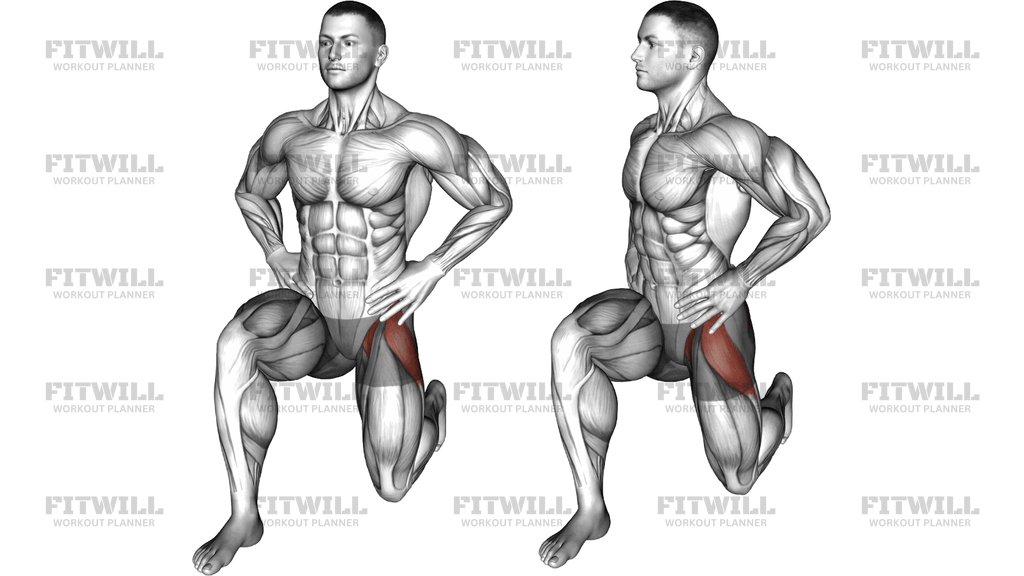
Kneeling Hip Flexor Frontal is a half-kneeling bodyweight stretch that lengthens the hip flexors of the rear leg while the front leg stays planted with the knee bent to roughly ninety degrees. Hands rest on the hips for balance and feedback, which makes it easy to feel whether the pelvis is level or twisting. The highlighted work happens at the front of the rear hip, where the iliopsoas and rectus femoris tend to get short from long hours of sitting.
This position matters because the rear knee being on the floor puts the hip into full extension before you add any pelvic tilt. From there, tucking the tailbone under and bracing the trunk is what actually creates the stretch. If you skip the pelvic tuck and just push the hips forward, the lower back arches and compensates, and the front of the hip barely lengthens at all. That is the single most common reason people do this stretch for months without feeling anything change.
It is useful for almost anyone who sits a lot, as well as runners, cyclists, and lifters whose squat or lunge depth is limited by tight hip flexors. It also pairs well before lower body training as a targeted mobility drill, since opening the front of the hip makes it easier to reach full extension in lunges and to keep the ribs stacked over the pelvis during squats.
To execute it well, think long spine and level hips rather than big forward movement. The shift of the pelvis is modest, often only a few centimeters, and the stretch should be felt deep at the front of the rear hip and possibly down the front of the rear thigh. Keep the front knee tracking over or slightly inside the ankle so it never drifts forward past the toes.
Because the hands are free and only the body weight is involved, you can do this anywhere: on a training floor, on a mat at home, or during a break at work. Hold each side for twenty to thirty seconds, breathe steadily, and repeat two to three rounds per side. If the rear kneecap is uncomfortable on a hard surface, fold a towel or use a mat under the knee.
[ Workout Log & Planner ]
Put your next workout in Fitwill
Keep your plan and training log ready when you are.


Instructions
- Kneel on one knee with the shin of that leg resting on the floor behind you and the top of the rear foot down.
- Plant the front foot flat on the floor directly under the front knee so both joints form roughly ninety-degree angles.
- Place both hands on your hips with your thumbs pointing back so you can feel whether your pelvis stays level.
- Tighten your trunk lightly and squeeze the glute of the rear leg to tilt your tailbone under before you move anything else.
- Keeping that glute squeezed, shift your hips slightly forward until you feel a stretch deep at the front of the rear hip.
- Hold the end position for twenty to thirty seconds without letting your lower back arch or your front knee slide forward.
- Breathe slowly through your nose, exhaling fully to let the rear hip sink a little deeper on each breath.
- Ease the hips back to the starting half-kneeling position under control instead of collapsing out of the stretch.
- Reset the pelvic tilt and glute squeeze, then repeat for two to three rounds before switching legs.
Tips & Tricks
- The glute squeeze on the rear leg is the whole exercise; without it, the pelvis dumps into an anterior tilt and the hip flexor never gets lengthened.
- If you feel the stretch mainly in your lower back rather than the front of the rear hip, you are arching instead of tucking. Pull the ribs down and re-tuck the tailbone.
- Check your hands on your hip bones: if one side has dropped lower, your pelvis is rotating. Square both sides forward before shifting.
- Do not chase a large forward lean. A small, well-tucked pelvic shift stretches the hip flexor more than pushing the whole torso ahead of it.
- Watch the front knee. If it collapses inward or shoots past the toes, shorten your stance slightly so the shin stays close to vertical.
- Pad the rear knee with a mat or folded towel on hard floors so discomfort at the kneecap does not make you tighten up and lose the stretch.
- If the front of the rear thigh dominates the stretch, that is the rectus femoris, which is normal in this position; keep the hold gentle rather than aggressive.
- Exhale into the stretch instead of holding your breath. Holding tension in the trunk keeps the hip flexors guarded.
- Do this before lunges, squats, or running rather than only after, since free hip extension improves your positions under load.
Frequently Asked Questions
Which muscles does Kneeling Hip Flexor Frontal target?
The main targets are the hip flexors of the rear leg, primarily the iliopsoas, along with the rectus femoris at the front of the thigh. The glute of the rear leg and the trunk muscles work isometrically to hold the pelvic tuck.
Why does my lower back hurt instead of my hip during the Kneeling Hip Flexor Frontal?
That usually means your pelvis is tipping forward and the stretch is spilling into the lumbar spine. Squeeze the glute of the rear leg harder, tuck the tailbone under, and reduce how far you shift the hips forward.
Is this exercise suitable for beginners?
Yes. The half-kneeling position is stable, no equipment is required, and the range is self-regulated by how far you shift. Beginners should focus only on the pelvic tuck and level hips before trying to deepen the stretch.
How long should I hold the Kneeling Hip Flexor Frontal?
Twenty to thirty seconds per side, repeated two to three rounds, works well for most people. If you sit for long hours daily, shorter, more frequent holds tend to be more practical than one long session.
Should I do Kneeling Hip Flexor Frontal before or after training?
It works well before lower body training because it frees up hip extension for lunges and squats. After training or on rest days, longer holds are fine for general mobility maintenance.
My rear kneecap hurts on the floor. What can I do?
Place a mat, folded towel, or pad under the rear knee. If the knee itself remains painful rather than just uncomfortable against the floor, switch to a standing hip flexor stretch variation where the knee is not loaded.
Why do I feel the stretch more in my front thigh than in my hip?
The rectus femoris crosses both the hip and the knee, so in this position it is often stretched alongside the hip flexors. That is normal; just keep the intensity moderate and the pelvis tucked so the hip still gets lengthened.
Can I make the Kneeling Hip Flexor Frontal harder?
Yes. Raise the arm on the same side as the rear knee overhead and lean slightly away from that side to add length through the hip flexor, or hold the end position longer while maintaining the glute squeeze.
How do I know my hips are level during the stretch?
With your hands on your hips and thumbs back, compare the height of your hip bones; they should stay even and square forward. A common mistake is letting the rear-side hip rotate or drop as you shift forward.