Kneeling Hip Flexor Transverse
The Kneeling Hip Flexor Transverse is a half-kneeling mobility drill that targets the hip flexors while adding a rotational, transverse-plane component that most static hip flexor stretches leave out. You set up in a lunge position with one knee down, then rotate your torso and pelvis over the front leg, which lengthens the hip flexors of the trailing leg from a slightly different angle than a straightforward push-the-hips-forward stretch.
This variation is especially useful for people who sit for long stretches of the day. Prolonged sitting keeps the hip flexors, particularly the iliopsoas and rectus femoris, in a shortened position, which can pull the pelvis into an anterior tilt and make standing tall or squatting deeply feel restricted. Because the trailing hip is placed into full extension before the rotation begins, the front of the trailing hip gets a strong, targeted stretch, and the turning motion encourages the pelvis and spine to move together rather than compensating at the lower back.
The half-kneeling stance itself does quiet but important work. The front leg stabilizes the ankle, knee, and hip in a stacked position, the glutes of the trailing leg must stay engaged to keep the hip extended, and the trunk muscles control the rotation so it comes from the hip and pelvis rather than from swinging the shoulders. That makes this drill a two-for-one: a lengthening effort for the hip flexors and a stability challenge for the trunk and front hip.
Setup matters more than range here. If the stance is too narrow, the trailing hip cannot reach full extension; if the front knee drifts past the toes or collapses inward, the stretch shifts into the knee joint. Keeping the hands on the hips, as this version is typically performed, gives you a physical reference point: you should feel your pelvis stay square and level as the ribs and torso turn over the front thigh.
Use the Kneeling Hip Flexor Transverse as a warm-up before lower-body training, running, or any session involving lunges and squats, or as a standalone mobility break on desk-heavy days. Move slowly, hold the rotated end position for a few breaths, and let the range improve over weeks rather than forcing depth in a single session. Mild stretch tension across the front of the trailing hip and thigh is the goal; any sharp pinching at the hip crease or discomfort in the down knee is a signal to shorten the stance or reduce the rotation.
If your down knee is sensitive, place a folded mat or towel under it. The exercise requires no equipment beyond that, so it travels well and fits into almost any warm-up or cool-down without setup time.
Fitwill
Log Workouts, Track Progress & Build Strength.
Achieve more with Fitwill: explore over 9600 exercises with images and videos, access built-in and custom workouts, perfect for both gym and home sessions, and see real results.
Start your journey. Download today!




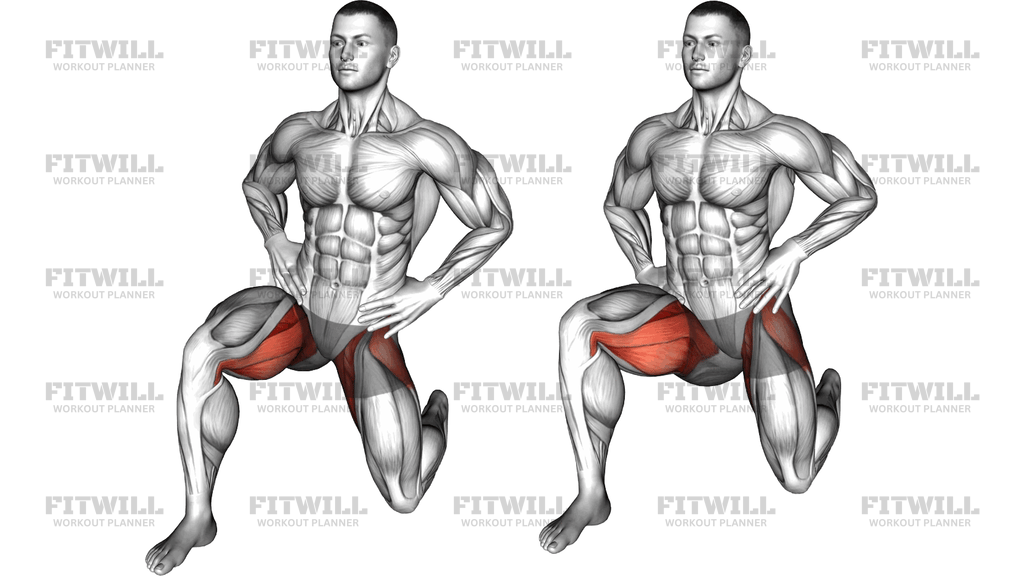
Instructions
- Kneel on an exercise mat and step one foot forward so both knees are bent at roughly 90 degrees, with the front foot flat on the floor directly under the front knee.
- Place both hands on your hips with your thumbs pointing back so you can feel whether your pelvis stays level throughout the movement.
- Tuck the tailbone slightly and squeeze the glute of the down-knee leg until you feel a stretch across the front of that trailing hip; keep the torso tall and ribs stacked over the pelvis.
- Brace the trunk lightly, as if preparing to be tapped in the stomach, so the lower back does not arch as you begin to turn.
- Slowly rotate your torso and pelvis over the front leg, leading with the chest while the hands on the hips track the turn, until you feel the stretch deepen in the front of the trailing hip.
- Pause at the rotated end position for two to three slow breaths, keeping the front knee stacked over the ankle and the trailing glute engaged the entire time.
- Rotate back to the square starting position under control, without letting the pelvis tip forward or the lower back take over the return.
- Exhale as you rotate into the stretch and inhale as you come back to center, keeping the breathing steady rather than holding your breath.
- Complete the desired number of slow repetitions on one side, then switch legs so the opposite hip flexor is the trailing leg and repeat.
Tips & Tricks
- If you feel a pinch at the front of the trailing hip instead of a lengthening stretch, shorten your stance slightly and re-tuck the tailbone before rotating; the pinch usually means the pelvis has tipped forward into an arch.
- Do not let the front knee cave inward as you turn. Press the front foot into the floor and keep the knee tracking over the second toe so the rotation comes from the hip, not the knee.
- A common mistake is turning only the shoulders while the pelvis stays frozen. Use your hands on the hips to confirm the pelvis itself rotates with the torso over the front thigh.
- Keep the glute of the down-knee leg working the whole set. If that glute switches off, the lower back takes the extension and the hip flexor stretch fades.
- Pad the down knee generously. Discomfort there will make you rush the rotation and steal range from the hip.
- Reach less far than you think you need to on the first few repetitions. Easing into the turn lets the hip flexors release gradually instead of guarding against a fast pull.
- Keep your gaze forward and your chest tall as you rotate. Looking down and rounding forward turns this into a spinal twist and reduces the work at the hip.
- If balance is shaky, widen the front foot slightly or place the hands on the front thigh for the first sets before returning them to the hips.
- Perform this drill before squats, lunges, or running rather than after heavy lifting, when the hip flexors are most responsive to mobility work.
Frequently Asked Questions
Which muscles does the Kneeling Hip Flexor Transverse primarily target?
The main targets are the hip flexors of the trailing leg, especially the iliopsoas and the rectus femoris at the front of the thigh. The glutes of the trailing leg and the obliques and trunk muscles work to control the rotational component.
What makes the transverse version different from a standard Kneeling Hip Flexor Stretch?
Instead of only pushing the hips forward, you rotate the torso and pelvis over the front leg, which biases the hip flexor fibers from a rotational angle and adds a trunk control demand that the static version does not have.
Is the Kneeling Hip Flexor Transverse suitable for beginners?
Yes, as long as the range is kept modest and the down knee is cushioned. Beginners should start with small rotations and focus on keeping the pelvis square and the trailing glute engaged before chasing a bigger turn.
Why do I feel this more in my lower back than in my hip?
That usually means the pelvis is tipping forward and the lumbar spine is extending to create the range instead of the hip. Re-tuck the tailbone, squeeze the trailing glute harder, and reduce the rotation until the stretch returns to the front of the hip.
How long should I hold each rotation?
Pause for two to three slow breaths at the rotated end position, then return to center. Repetitions with short holds tend to work better as a warm-up than one long static hold.
Can I do the Kneeling Hip Flexor Transverse every day?
For most people, yes. It is a low-load mobility drill, so daily use, especially after long sitting periods, is generally reasonable as long as the down knee stays comfortable.
My down knee hurts when I kneel. What should I change?
Place a folded mat, pad, or towel under the knee, and make sure your weight sits through the hip rather than pressing directly down into the kneecap. If discomfort persists, a standing hip flexor stretch with the same rotational element is a reasonable substitute.
Should I hold my breath during the rotation?
No. Exhale as you rotate into the stretch and inhale on the way back. Steady breathing helps the trunk stay braced without building excess tension.
When is the best time to use this drill in a workout?
It works well as part of a warm-up before squats, lunges, deadlifts, or running, when opening the front of the hip helps you reach a better stance. It can also be used on its own as a mobility break during the day.
How far should I rotate during the movement?
Rotate only until you feel a clear but comfortable stretch across the front of the trailing hip while the pelvis stays level and the front knee stays stacked over the ankle. Depth should improve gradually over weeks, not within one session.