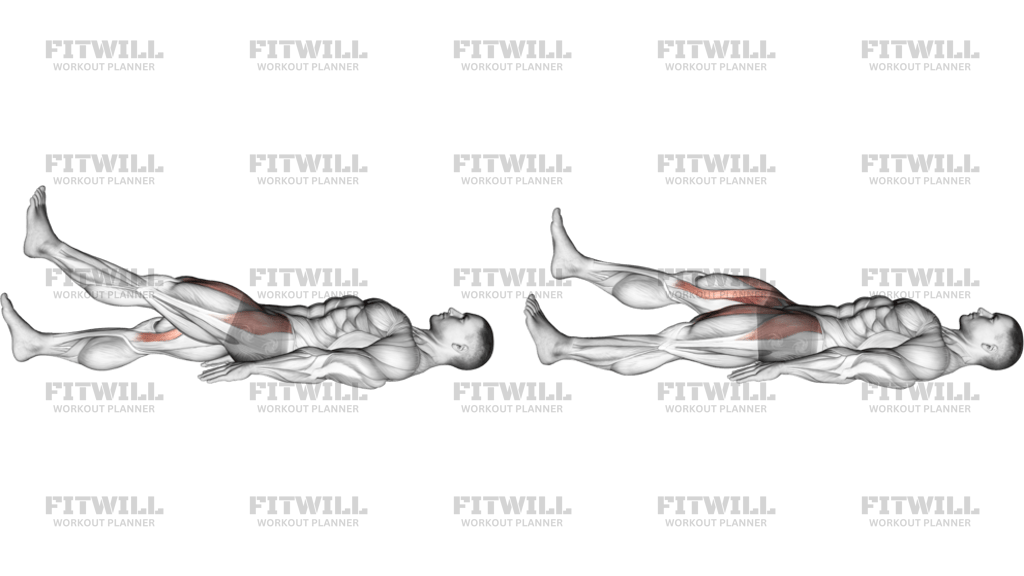
Lying Alternate Knee Flexion
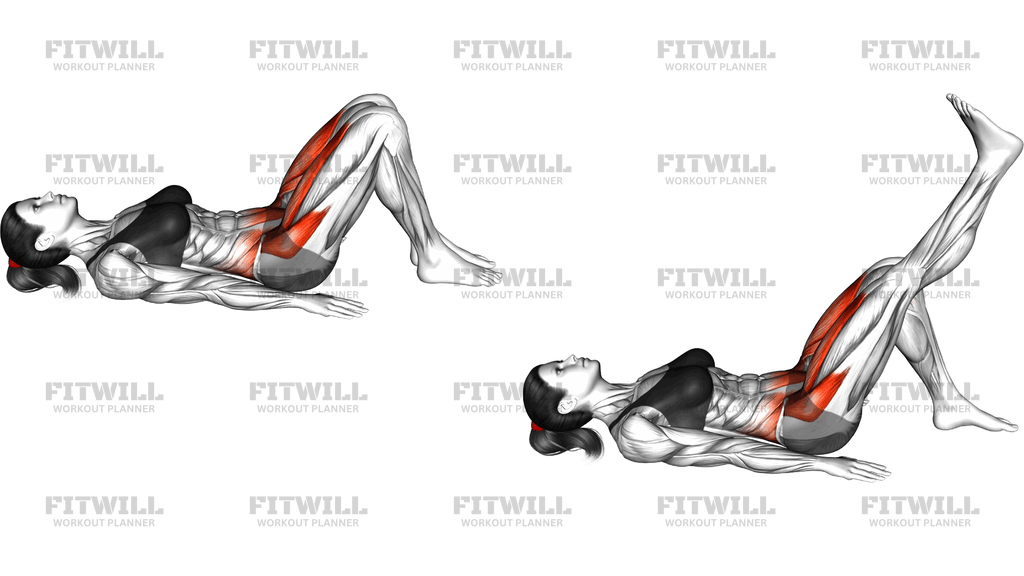
Lying Alternate Knee Flexion is a floor-based hip flexor and core exercise performed from a supine position with the knees bent and feet flat. From there, you draw one knee up toward your chest while the opposite leg stays planted, then lower it back down and repeat on the other side in an alternating rhythm. Because the torso stays anchored to the floor the entire time, the hip flexors do the bulk of the driving work while the deep abdominal muscles work continuously to keep your pelvis and lower back from arching or rocking.
The setup looks simple, but that is exactly what makes it valuable. With your back on the floor and arms relaxed at your sides, the exercise removes almost all balance demands and external load, so you can focus purely on controlling the hip joint through its range. This makes it a good choice for people building basic hip flexion strength, warming up before running or lower body training, or reintroducing controlled knee movement after long periods of sitting.
The main muscles working are the hip flexors, especially the iliopsoas and rectus femoris, which lift the thigh toward the torso. The lower abs and transverse abdominis act as stabilizers, holding the ribcage down and keeping the lumbar spine neutral as each leg moves independently. The standing or planted leg also stays quietly active through the thigh and glute to hold its position, which adds a subtle anti-rotation demand to the work.
Execution quality comes down to tempo and pelvic control. Each knee should be pulled up deliberately, without yanking, and lowered under control until the foot returns to the floor. If you rush the movement or let the lower back peel off the ground, the hip flexors stop doing clean work and the lumbar spine starts compensating. Slowing down and keeping the movement smooth is what turns this from a casual leg motion into a genuine training stimulus.
You will see this exercise used in warm-ups, rehab-adjacent conditioning, Pilates-style mat work, and beginner core circuits. It pairs naturally with glute bridges, dead bugs, and pelvic tilts as part of a supine series. Because it requires no equipment beyond a bit of floor space, it is easy to slot into home sessions or hotel room workouts.
From a safety standpoint, the main thing to watch is the lower back. If you feel strain or arching in the lumbar spine, reduce the range, move more slowly, or keep both feet closer to the body. Stop if you feel pinching at the front of the hip and reassess your positioning before continuing.
[ Workout Log & Planner ]
Put your next workout in Fitwill
Keep your plan and training log ready when you are.


Instructions
- Lie flat on your back on an exercise mat with your knees bent and both feet flat on the floor, roughly hip-width apart.
- Rest your arms alongside your body with palms facing down, and let your head and shoulders relax against the mat.
- Gently brace your abdominal muscles and press your lower back toward the floor so your pelvis sits in a neutral, stable position.
- Exhale and lift one knee, drawing it up toward your chest until the thigh approaches your torso while the opposite foot stays planted.
- Pause briefly at the top with the knee flexed, keeping your hips and shoulders square and flat on the mat.
- Inhale and lower the leg slowly, guiding the foot back to the floor under control rather than dropping it.
- Repeat the same knee lift on the opposite leg, keeping the first foot planted as the second knee comes up.
- Continue alternating legs for your target number of repetitions, maintaining the same slow tempo on both sides.
- To finish, place both feet back on the floor, release the brace, and rest for a moment before standing up.
Tips & Tricks
- If your lower back arches as the knee lowers, shorten the range so the foot only descends partway before you switch sides.
- Avoid pulling the knee with your hands; the hip flexors should lift the thigh on their own.
- Keep the planted foot from sliding or rolling outward as the other knee rises, since that usually means the pelvis is rotating.
- Point your pacing at the lowering phase, not the lift, most people snap the leg down and lose the strengthening half of the rep.
- If you feel a pinch at the front of the hip at the top of the lift, reduce how far the knee travels toward the chest.
- Do not let the pelvis tilt or the ribs flare upward as each knee rises; imagine zipping the lower abs toward the spine throughout.
- Keep the neck relaxed and the head resting on the mat, since straining forward does nothing for the hips and only tenses the neck.
- Breathe steadily on each rep instead of holding your breath; exhale on the lift and inhale on the descent.
Frequently Asked Questions
What muscles does Lying Alternate Knee Flexion work?
The primary movers are the hip flexors, mainly the iliopsoas and rectus femoris, which pull each thigh toward the chest. The lower abs and transverse abdominis stabilize the pelvis and spine while the legs alternate.
Is Lying Alternate Knee Flexion suitable for beginners?
Yes, it is one of the more accessible hip flexor exercises because it is done lying down with no external load. Beginners should simply start with a smaller range of motion and a slow, controlled tempo.
Why does my lower back arch during the exercise?
Arching usually means the hip flexors are pulling on the pelvis faster than the abdominals can stabilize it. Slow the descent, brace the abs more firmly, and shorten the range until you can keep the back flat against the mat.
How is Lying Alternate Knee Flexion different from a dead bug?
A dead bug also extends the opposite arm overhead, adding a cross-body coordination and anti-extension demand. This exercise keeps the arms at your sides and focuses more narrowly on controlled hip flexion one leg at a time.
Should I feel this in the front of my hip?
Some working sensation at the front of the hip is expected since that is where the hip flexors sit. Sharp pinching is not; reduce the range or check that your pelvis stays neutral rather than tilting.
Can I use Lying Alternate Knee Flexion as a warm-up?
It works well as a pre-run or pre-lift warm-up because it activates the hip flexors and deep core without fatigue. Two or three sets of slow alternating reps is usually enough before lower body activity.
How many repetitions should I do?
Start with 8 to 12 alternating lifts per side, focusing on smooth tempo and a stable pelvis. Increase reps or slow the lowering phase once that feels easy rather than adding external weight.
Can I do this exercise on a bed instead of the floor?
A firm surface like a floor or mat is better because a soft bed lets the pelvis and spine sink and shift. The stability of the floor is what makes the core control component of the exercise work.