Side Step Front Punches
Side Step Front Punches combine a lateral weight shift with a straight punch thrown across the front of the body, making it one of the most practical stand-up conditioning drills you can do without any equipment. You start in a fighting-style guard with both fists at chin height and knees softly bent, then step to one side and drive a front punch out from the shoulder while the opposite arm stays anchored at your face. The movement repeats side to side, so your legs never stop working and your upper body stays constantly engaged.
This is a full-body drill by design. The stepping leg and adductors control the side-to-side weight transfer, the quads and glutes absorb each landing, and the front shoulders, chest, and triceps power the punch. Because the punch crosses slightly toward the midline as you step, your obliques and deep core rotate to connect the lower and upper body — that hip-to-shoulder transfer is exactly what makes punches feel sharp instead of arm-only.
Side Step Front Punches work well as a warm-up primer before upper body lifting, as a standalone cardio interval, or as part of a kickboxing-style circuit. Beginners can slow the tempo down and focus purely on coordination, while more advanced trainees can speed up the step-punch rhythm or extend work intervals to 40–60 seconds to raise the heart rate meaningfully. It also doubles as a low-impact alternative to jumping drills, since one foot always stays in contact with the floor.
Setup matters more than most people expect. Your stance width, guard height, and knee bend all determine whether the punch comes from your hips or gets cheated out of your arm alone. Stand with feet roughly hip-width apart, fists closed but not clenched tight, elbows tucked close to the ribs, and weight balanced over the middle of each foot. If your guard drops as you fatigue, the drill quickly turns into sloppy arm swinging, so treat the returning hand as a moving checkpoint.
To execute well, step sideways and let the punch land as your foot does, exhaling sharply through the extension. Keep the punching arm moving in a straight line from chin to target height — about chest level — and retract it along the same path rather than letting it drift wide. The non-punching hand should stay glued near your cheek the entire time; this small detail keeps your shoulders from rolling forward and your chin from jutting out.
The most common errors are stepping too wide and losing balance, punching with a locked elbow, and letting the torso lean back instead of rotating. Stay tall through the spine, keep the knees soft, and think of each rep as a step-and-breathe rhythm rather than two separate movements. Stop the set when your guard height or footwork quality drops — crisp reps build coordination, rushed ones just reinforce bad habits.
[ Workout Log & Planner ]
Put your next workout in Fitwill
Keep your plan and training log ready when you are.


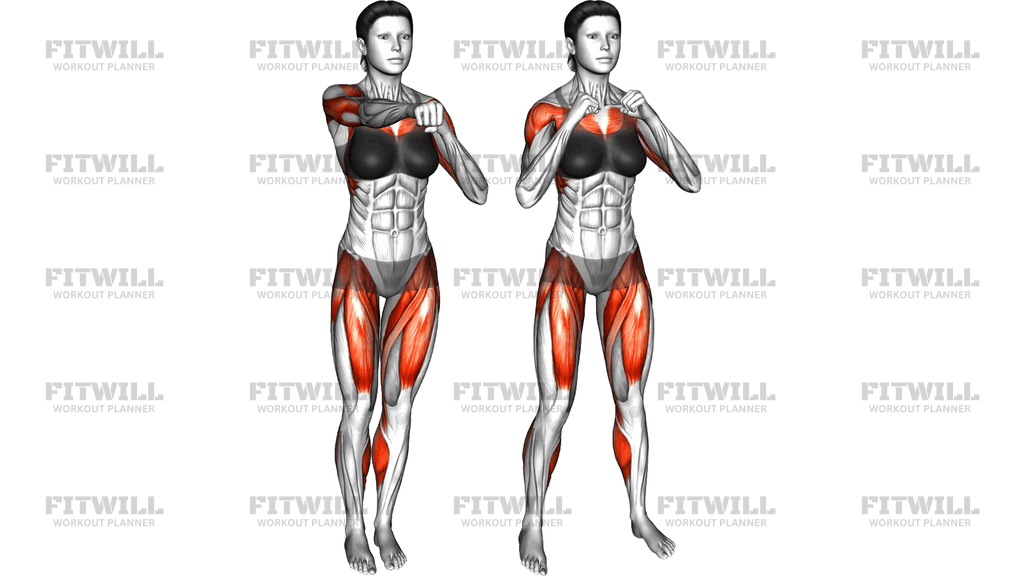
Instructions
- Stand with your feet about hip-width apart, knees softly bent, and your weight balanced over the midfoot.
- Raise both fists to chin height in a guard position, elbows tucked against your ribs, shoulders relaxed and down.
- Brace your core lightly and keep your chest tall, as if a string is lifting the crown of your head.
- Step sideways with one foot, letting your hips shift with the step while the opposite foot follows or stays planted for balance.
- As your stepping foot lands, extend one fist straight forward to about chest height, rotating the punch slightly from the shoulder and hip.
- Keep the non-punching hand pressed near your cheek so your guard never drops during the punch.
- Exhale sharply as the punch extends, then inhale as you retract the fist along the same straight path back to your chin.
- Immediately step to the opposite side and punch with the other arm, building a steady side-to-side rhythm.
- Continue alternating for your planned time or rep count, resetting your stance and guard whenever the rhythm breaks down.
Tips & Tricks
- If you find yourself punching with a straight, locked elbow, cut the extension short by a few degrees — the arm should snap out and back, not slam to a stop.
- A dropped rear hand is the most common fault in Side Step Front Punches; check your guard height after every third punch until it becomes automatic.
- Keep your steps controlled and moderate in width. Oversized steps pull your weight outside your base and turn the drill into a balance exercise instead of a punch drill.
- Let your hips rotate into the punch rather than reaching with the shoulder — if only your arm is moving, slow down and re-link the step to the punch timing.
- Stay on the balls of your feet with light bounce in the knees; heavy flat-footed landings fatigue the quads early and slow the transition between sides.
- Avoid leaning your torso backward or sideways as you punch. If you can't stay tall, reduce your speed before you reduce your range.
- For a cardio-focused set, keep the pace brisk and continuous for 30–60 seconds; for technique work, slow the tempo and pause briefly in the guard between reps.
- Keep your fists relaxed until the moment of extension. Constantly clenched fists create forearm and shoulder tension that wrecks your rhythm.
- If your shoulders creep upward toward your ears, consciously pull your shoulder blades down before your next step.
Frequently Asked Questions
What muscles do Side Step Front Punches work?
The front shoulders, chest, and triceps drive each punch, while the quads, inner thighs, and glutes handle the side-stepping. The obliques and core rotate to connect the step with the punch.
Is Side Step Front Punches good cardio even without weights or a bag?
Yes. The continuous side-to-side stepping plus repeated punching keeps the heart rate elevated, and you can raise the intensity simply by increasing your speed and extending work intervals.
How high should I punch during Side Step Front Punches?
Aim for roughly chest or chin height, in line with where a target would sit. Punching lower drops your guard posture, and punching higher strains the shoulder.
Should both feet move when I step to the side?
The lead foot steps out first and the trailing foot can either follow partway or stay planted, as long as your weight stays balanced and you can immediately push back the other direction.
Can beginners do Side Step Front Punches?
Absolutely. Start slowly with a smaller step and a lighter punch to learn the step-and-punch timing, then build speed once the rhythm feels natural.
Why does my rear hand keep dropping when I punch?
This usually happens when you focus only on the punching arm. Consciously keep the non-punching fist at your cheek and check its position after every few reps until it stays there on its own.
What can I substitute if stepping side to side bothers my knees?
Reduce the step width and keep more bend in the knees, or perform the punch rhythm with only a small weight shift from foot to foot. The upper body pattern stays the same either way.
How long should a set of Side Step Front Punches last?
For conditioning, 30–60 seconds of continuous alternation works well; for technique practice, use shorter sets of 15–20 seconds so your guard and footwork stay crisp.
Is it safe to fully lock out the elbow on each punch?
No. Punching with a locked elbow sends force into the joint instead of through the movement. Extend firmly but keep a small amount of bend so the arm can retract quickly and safely.