Deep Lunge Thoraic Stretch
The Deep Lunge Thoracic Stretch combines a long, low lunge position with a forward fold over the front leg, targeting two areas that most desk-bound bodies desperately need: the front of the back hip and the mid-upper back. You drop into a deep split stance with the back knee lowered toward the floor, sink your hips down and forward, then reach your hands to the floor inside the front foot and let your upper back lengthen and round as your chest moves toward the front thigh. The result is a stretch that opens the hip flexors while simultaneously mobilizing the thoracic spine in flexion.
This movement is especially useful for people who sit for long stretches. Sitting keeps the hip flexors, particularly the iliopsoas, in a shortened position all day, and it also encourages a stiff, rounded-but-immobile upper back. The Deep Lunge Thoracic Stretch addresses both in one position, which is why it shows up so often in warm-ups for squatting and running as well as in evening mobility routines. Lifters who struggle to reach full depth in a squat or who feel pinched at the front of the hip during lunging patterns often find this drill helps them move more freely.
The setup matters more than it looks. The distance between your feet determines everything: too short a stance and your front knee jams forward past the toes while the back hip never truly lengthens; too long a stance and you lose the ability to sink down and fold. Aim for a stance long enough that your front shin stays roughly vertical while your back hip can travel forward and down. Your hands should reach the floor comfortably on either side of the front foot; if they don't, that's fine for the hip portion, but the thoracic fold will be limited.
To execute it well, think of two separate actions happening at once. From the hips, press forward and down so the stretch lands in the front of the back hip, keeping the glute of the back leg engaged to protect the lower back. From the torso, let the chest drift down toward the front thigh while the arms reach long, allowing the upper back to round naturally rather than forcing the fold with the lower back. Breathe slowly and deeply, letting each exhale soften the position a little more. Hold each side for 20 to 40 seconds, and repeat two to three rounds if you're using it as a standalone mobility block.
A few practical points keep this safe and effective. Cushion the back knee with a mat or soft surface, since a hard floor encourages you to hover and tense up. Keep the front knee tracking over the toes rather than caving inward. If folding all the way down is uncomfortable, rest your hands on a low block or your front thigh and gradually work lower over time. Never bounce in the end position; the stretch should feel strong but controllable, and any sharp sensation in the front of the hip, the knee, or the lower back is your cue to shorten the stance and reset.
[ Workout Log & Planner ]
Put your next workout in Fitwill
Keep your plan and training log ready when you are.


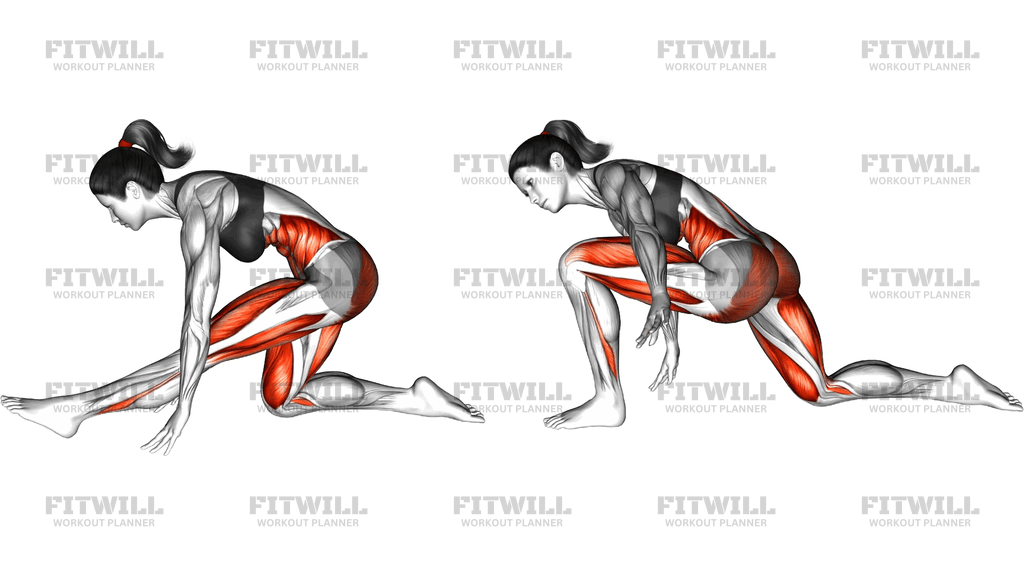
Instructions
- Kneel on one knee with a mat or pad under it, and place the opposite foot flat on the floor in front of you so the front knee stacks roughly over the ankle.
- Walk the front foot forward until you have a long, stable split stance, and check that your front shin stays close to vertical.
- Place both palms flat on the floor on either side of the front foot, fingers pointing forward, and let your back knee rest fully on the padding.
- Brace lightly through the trunk, squeeze the glute of the back leg, and press your hips forward and down until you feel a clear stretch along the front of the back hip.
- Keeping your back long and controlled, allow your chest to fold down toward the front thigh while your arms reach long in front of you, letting the upper back round into the stretch.
- Hold the end position for 20 to 40 seconds, breathing slowly through the nose and letting each exhale release a little more tension from the hips and upper back.
- To come out, press your hands into the floor, lift the chest back up, and shift your weight back over the front foot.
- Bring the back knee forward, switch legs, and complete the same hold on the other side.
- Repeat two to three rounds per side if you're using this as a dedicated mobility drill before or after training.
Tips & Tricks
- If your front knee drifts past the toes and the heel lifts, your stance is too short; scoot the front foot forward a few centimeters so the shin can stay near vertical.
- Don't force the fold from the lower back. If your midsection collapses instead of your upper back rounding, squeeze the back-leg glute and think of reaching the chest toward the front knee rather than the floor.
- Hovering the back knee off the floor tightens the hip flexor you're trying to lengthen. Let it rest fully on the padding so the stretch actually reaches the front of the hip.
- Exhale as you settle deeper into the hold. Holding your breath keeps the trunk rigid and shortens the stretch on both the hip flexors and the upper back.
- If your hands can't reach the floor, place them on two low blocks or books instead of straining forward and losing the hip position.
- Keep your shoulders relaxed and away from your ears as your arms reach; shrugging turns this into a neck and shoulder tension exercise rather than a thoracic stretch.
- Watch that the front knee tracks over the middle of the foot. Letting it cave inward shifts stress to the knee joint and blurs the hip stretch.
- Avoid bouncing at the end range. A slow, steady hold with a couple of deep breaths gives better results than pulsing in and out of the fold.
Frequently Asked Questions
What muscles does the Deep Lunge Thoracic Stretch target?
The primary targets are the hip flexors of the back leg, especially the iliopsoas, along with the glutes and hamstrings of the front leg to a lesser degree. The forward fold also lengthens the muscles along the upper and mid back, including the lats.
Is the Deep Lunge Thoracic Stretch suitable for beginners?
Yes, as long as the stance is kept modest and the hands are supported on blocks or the front thigh if the floor is out of reach. Beginners should start with a 15 to 20 second hold per side and prioritize a vertical front shin over depth.
Why should my back knee be on the floor during this stretch?
Resting the back knee lets that hip fully lengthen and relaxes the leg so the stretch lands in the hip flexor instead of being held by muscle tension. Use a mat or pad so the knee can genuinely settle rather than hover.
Can I do the Deep Lunge Thoracic Stretch before a workout?
It works well as part of a warm-up for squats, lunges, or running because it opens the hips and mobilizes the upper back. Keep holds on the shorter side, around 20 seconds, so you feel open rather than overly lengthened before loading.
The front of my back hip pinches when I fold forward. What should I change?
Shorten your stance slightly, squeeze the back-leg glute harder, and reduce how far the hips travel forward. A pinch at the front of the hip usually means the femur is pressing into the hip socket rather than the muscle lengthening.
How is this different from a regular low lunge stretch?
A regular low lunge stays upright and focuses on the hip flexors. Here, the added forward fold with arms reaching long brings the thoracic spine into the movement, stretching the upper back at the same time as the hip.
How long should I hold each side?
Twenty to forty seconds per side works for most people, repeated two to three rounds. Longer holds closer to a minute are useful in a dedicated evening mobility session when you're not about to train.
What can I use instead if kneeling hurts my knee?
Place a folded towel or thick pad under the knee, or perform a standing variation with the back foot elevated slightly behind you and the hands on a bench as you fold toward the front leg. The key elements are the lengthened back hip and the forward fold.
How often should I include the Deep Lunge Thoracic Stretch in my routine?
Daily use is fine for most people, especially if you sit for long periods. Consistency with short sessions generally does more for hip and upper back mobility than occasional long holds.