Side Step Row
The Side Step Row combines two jobs into one flowing movement: you step out to the side against the pull of a resistance band, and as you plant that foot you row the band's handles in toward your chest. It is essentially a horizontal row and a lateral step-up rolled together, so your upper back works through the pull while your hips and legs control the step. Because the band stays under tension the whole time, your arms never fully get to rest between repetitions.
This exercise earns its place in a routine when you want more from a plain row. Office workers and anyone who spends long hours at a desk often have sleepy mid-back muscles and a rounded upper spine, and the rowing portion directly targets the rhomboids and mid-traps that pull the shoulder blades back. The stepping portion then asks the glute muscles on the side of the hip to stabilize and drive, which is something a seated row simply cannot do.
Setup matters more here than in most band exercises because the tension has to be even on both sides. Anchor the band at roughly chest height, take a handle in each hand, and walk back until your arms are extended forward with light tension before you even begin stepping. If the anchor is too high or too low, the pull angle changes and the row stops hitting the middle of your back cleanly.
To execute it well, keep your torso tall and your eyes forward as you step one foot out to the side. Pull the handles toward your lower chest, leading with your elbows and squeezing your shoulder blades together at the front of the movement. The step and the row should finish together, then you reverse both at the same controlled pace: extend the arms as the foot returns to the start. Alternate sides each rep, or complete all reps on one side before switching.
You will see this movement used in warm-ups for upper-body days, in home workouts where a single band has to cover a lot of ground, and in conditioning circuits where a coach wants pulling volume without a cable stack. It also works well as a low-impact exercise, since the lateral stepping loads the hips gently while still raising the demand on the core to keep your torso from twisting.
From a safety standpoint, the main things to respect are the anchor point and your lower back. Make sure the band is secured to something solid at chest height and inspect it for wear before every session. During the row, resist the urge to lean back or arch; if your torso starts swinging, the load is too heavy or the tension is too great, so step closer to the anchor and reset.
[ Workout Log & Planner ]
Put your next workout in Fitwill
Keep your plan and training log ready when you are.


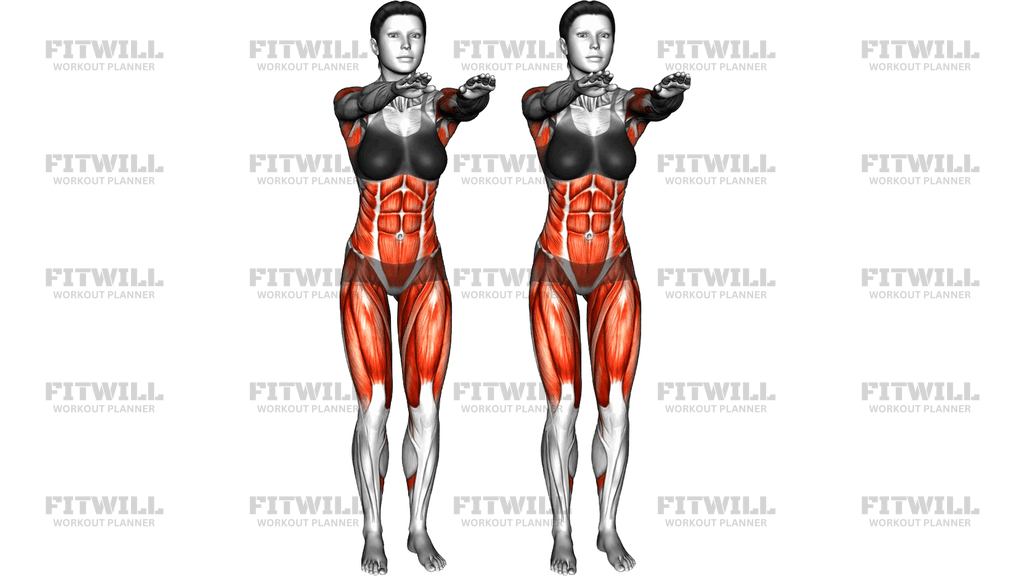
Instructions
- Anchor a resistance band at about chest height to a sturdy post or door anchor, and check that it is secure before loading it.
- Grip one handle in each hand and walk back until your arms are extended straight forward at chest height with light, even tension on both sides of the band.
- Stand tall with your feet hip-width apart, soft knees, and your shoulders stacked over your hips; brace your abdominal muscles so your torso does not twist.
- Step your right foot out to the side into a wider stance while keeping your torso facing forward.
- As the foot lands, pull both handles toward your lower chest, driving your elbows back past your ribs.
- Squeeze your shoulder blades together at the end of the pull, holding the position for a brief moment.
- Reverse the movement in one controlled motion: extend your arms fully as your right foot steps back to the starting stance.
- Exhale as you step and row, and inhale as you return to the extended starting position.
- Repeat on the left side, alternating legs each rep or completing all reps on one side before switching.
- At the end of the set, walk forward toward the anchor to release band tension before letting go of the handles.
Tips & Tricks
- If your torso rocks backward on each pull, the band tension is too heavy for your rowing strength; shorten the range by stepping closer to the anchor.
- Keep the handles at lower-chest height rather than pulling to your chin, so the elbows stay on a horizontal path and the mid-back does the work instead of the upper traps shrugging.
- Watch that your stepping foot lands with the whole foot flat; landing on the toes shifts the balance challenge onto the calf and makes the hips wobble.
- Do not let the band slacken when your arms extend between reps. If the band goes loose, take a half step back from the anchor to restore continuous tension.
- Your knees should track over the toes as you step out. If the stepping knee caves inward, consciously push it outward and narrow your step until the position is stable.
- Alternate sides rep for rep at first so you can spot a strength difference between your left and right rows and address it before it becomes a habit.
- Avoid letting your wrists bend back as you pull; keep the backs of the hands in line with the forearms so the forearms stay relaxed and the grip does not fatigue early.
- On the return, move the arms and the foot together rather than snapping the band back first. The eccentric portion is where much of the mid-back control is built.
Frequently Asked Questions
Which muscles does the Side Step Row work the most?
The primary work comes from the mid-back, mainly the rhomboids and middle trapezius, with the biceps and rear shoulders assisting the pull. The lateral step adds demand on the glutes, especially the hip stabilizers, and the core works to keep your torso from rotating.
Is the Side Step Row suitable for beginners?
Yes, as long as you start with a light band and stand close enough to the anchor that the tension is modest. Master the row with both feet planted first, then add the side step once you can pull without leaning back.
How high should I anchor the band for the Side Step Row?
Set the anchor at roughly chest height so the band runs level with your hands when your arms are extended. An anchor that is too high turns the pull into a downward angle and reduces the work at the middle of your back.
Why do my shoulders shrug up during the Side Step Row?
Shrugging usually means the upper traps are taking over because the load is too heavy or the pull path is drifting upward. Pull the handles to your lower chest, keep the elbows close to your ribs, and reduce the tension until the shrug disappears.
Can I do the Side Step Row without a band?
You can perform the same step-and-pull pattern at a cable machine with two handles set at chest height. The band is usually more convenient for home training, but the cable version gives a smoother resistance curve.
Should I alternate sides or finish all reps on one leg?
Alternating sides each rep keeps the movement rhythmic and is best for most people. If you notice one side is noticeably weaker or less stable, add a few extra reps on that side at the end of the set.
How wide should my side step be?
Step out only as far as you can while keeping the whole foot flat, the knee tracking over the toes, and your torso upright. A controlled narrower step trains the hips better than a wide step that forces your torso to tip.
Is the Side Step Row safe for the lower back?
It is generally well tolerated because the load comes from the band rather than from weight on your spine. The risk comes from leaning back as you row, so keep your abdominals braced and lower the tension if your torso starts to swing.
How many sets and reps of the Side Step Row should I do?
Two to four sets of 10 to 16 reps per side works well for strength and muscle endurance. Since the band tension depends on how far you stand from the anchor, adjust your distance so the last few reps feel challenging but remain controlled.