Hands Up Knee Drive
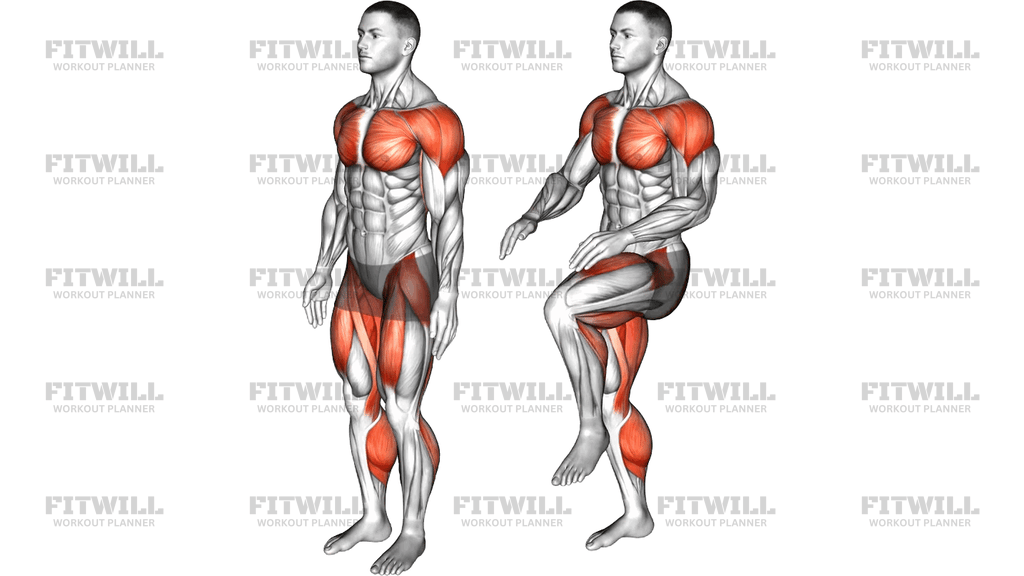
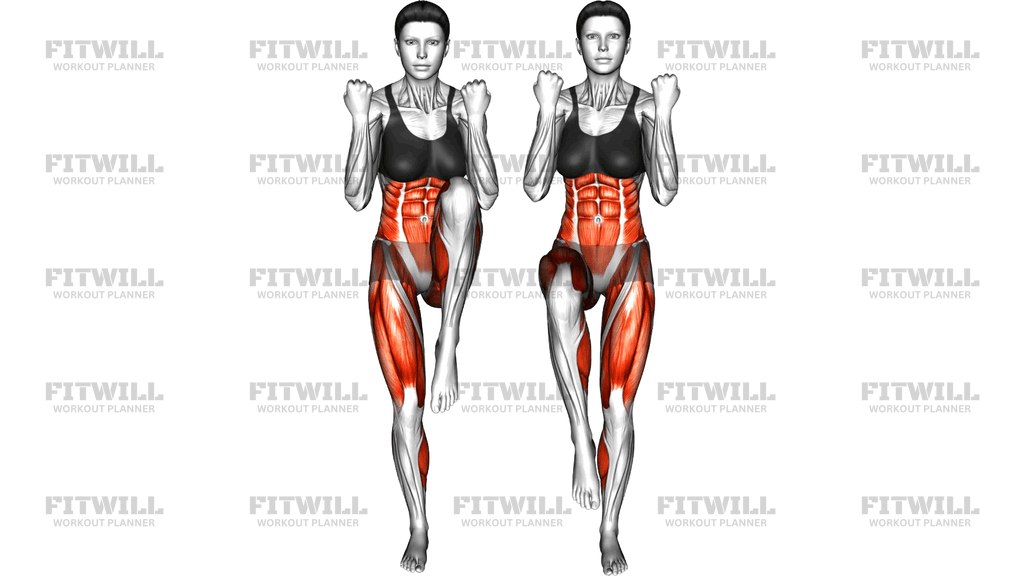
The Hands Up Knee Drive is a standing body weight movement where you keep both fists raised to shoulder height and drive one knee up toward your torso, then alternate. The raised hands are what separate this from a standard standing knee raise: with your arms locked in that high position, you cannot swing your arms or lean on momentum to help, so the work shifts squarely onto your hip flexors, lower abs, and the stabilizing muscles of the standing leg.
This exercise suits anyone who wants to train the core and hips without getting on the floor, from beginners building basic single-leg balance to runners and field sport athletes who need strong, coordinated knee lift under fatigue. Because it is done standing and can be sped up or slowed down, it works both as a strength drill when performed slowly with a pause and as a conditioning drill when performed at a brisk, controlled tempo.
The main muscles working are the hip flexors, especially the iliopsoas and rectus femoris, which pull the thigh up toward the trunk. The lower abs and obliques brace the spine and keep the ribcage from flaring as the knee rises, while the glutes and calf of the supporting leg handle balance and keep the pelvis level. Holding the hands up also lightly engages the shoulders and upper back isometrically, so the whole body has to stay organized throughout the set.
Setup matters more than most people expect. Stand tall with feet about hip width apart, elbows bent, and fists up beside your head rather than drifting forward. A stacked posture, with ears over shoulders over hips, gives the knee a clear path and stops the low back from compensating for tight hip flexors. If you lean back every time the knee comes up, you are robbing the abs of work and loading the spine instead.
To execute it well, brace your midsection, shift your weight onto one leg, and pull the opposite knee up until the thigh is at least parallel to the floor, or higher if your mobility allows. Pause for a beat at the top, lower the foot back under control, and repeat on the other side. The knee should travel straight up in front of you, not across the body or out to the side.
Common use cases include dynamic warm-ups, core circuits, home workouts with no equipment, and low-impact conditioning intervals. Start with two or three sets of eight to ten drives per side if you are new, and progress by slowing the tempo, adding a two-second hold at the top, or increasing the pace while keeping your torso tall.
Fitwill
Log Workouts, Track Progress & Build Strength.
Achieve more with Fitwill: explore over 9600 exercises with images and videos, access built-in and custom workouts, perfect for both gym and home sessions, and see real results.
Start your journey. Download today!




Instructions
- Stand with your feet hip width apart, weight evenly distributed, and your posture tall with ears, shoulders, and hips stacked.
- Raise both arms and hold your fists up beside your head at about shoulder height, elbows bent and tucked in, and keep them there for the entire set.
- Brace your abdominal muscles as if bracing for a light push, and pull your ribcage down so your lower back is not arched.
- Shift your weight onto one leg and lift the heel slightly to find your balance before moving.
- Drive the opposite knee straight up in front of you until the thigh is at or just above parallel with the floor.
- Pause for one second at the top with the knee high and your torso still upright.
- Lower the foot back to the floor under control rather than letting it drop, and settle your balance on the standing leg.
- Exhale as you drive the knee up and inhale as you lower it back down.
- Repeat on the other leg and continue alternating for the desired number of repetitions.
- Between sets, shake out your legs and reset your posture with fists raised before starting the next set.
Tips & Tricks
- The most common mistake is leaning the torso backward as the knee rises. If you feel your lower back arch, think about pulling the knee up with your lower abs instead of swinging it, and cap the height at whatever level you can hold without leaning.
- Keep your fists beside your head for the whole set. If your hands drift forward or down, the movement turns into a loose standing march and loses the core demand, so imagine holding an invisible bar across your shoulders.
- Do not let the knee angle outward or swing across your midline. Drive it straight up toward your chest so the hip flexors work in a clean line.
- If you wobble on the standing leg, widen your stance slightly and press the big toe into the floor. Balance usually improves within a few sessions, so shorten the range before you sacrifice stability.
- Point the knee, not the whole body. Some people rotate their hips and shoulders toward the driving leg; keep your chest facing forward the entire time.
- Slow it down before speeding it up. A two-second lift with a one-second hold builds more control than fast, sloppy reps, and you can add pace once your form holds at speed.
- If your hip flexors cramp, that is a sign they are doing real work for the first time. Lower the knee height, complete fewer reps, and stretch the hip flexors after your set.
- Drive through a flat, stable foot on the support leg; rising onto the toes early makes balance harder and adds nothing to the knee drive itself.
Frequently Asked Questions
What muscles does the Hands Up Knee Drive work?
The hip flexors do the main lifting, with the lower abs and obliques bracing your torso and keeping it upright. The glutes and calf muscles of the standing leg work to keep you balanced.
Why are the hands kept up during the Hands Up Knee Drive instead of swinging the arms?
With your fists held at shoulder height, you cannot use arm swing to generate momentum, so the hip flexors and abs have to produce the lift themselves. It also makes it obvious when you start leaning back, because the hands will drift forward.
Is the Hands Up Knee Drive suitable for beginners?
Yes. Beginners should start with a lower knee height, around thigh parallel to the floor, and move slowly while holding onto nothing. If balance is an issue, stand near a wall for reassurance without leaning on it.
How high should I drive my knee?
Aim for at least thigh parallel to the floor, and go higher only if you can keep your torso tall and your lower back neutral. Height without posture is not worth much in this exercise.
Can I do the Hands Up Knee Drive as cardio?
Yes. Once you can alternate knees smoothly with good posture, raising the tempo turns it into a low-impact conditioning drill. Keep the knee lift high and the hands up, or it becomes an easy standing march.
What is the most common mistake with this exercise?
Leaning the torso backward each time the knee drives up. This shifts work away from the abs and stresses the lower back, so pull the ribcage down and lift the knee only as high as you can while staying upright.
What can I use instead of the Hands Up Knee Drive?
A standard standing knee raise, a high-knee march, or a slow alternating high-knee hold all train similar hip flexor and core patterns. Floor-based reverse crunches or lying knee tucks cover the lower abs without the balance demand.
How many repetitions should I do?
For strength and control, start with two or three sets of eight to ten drives per side at a slow tempo. For conditioning, work in timed intervals of twenty to thirty seconds while keeping each rep clean.
Is it safe for my lower back and knees?
For most people, yes, as long as you keep the torso upright and avoid forcing the knee higher than your hips comfortably allow. If you have a current back, hip, or knee issue, use a smaller range and stop if the movement causes pain rather than effort.