Resistance Band Standing Row
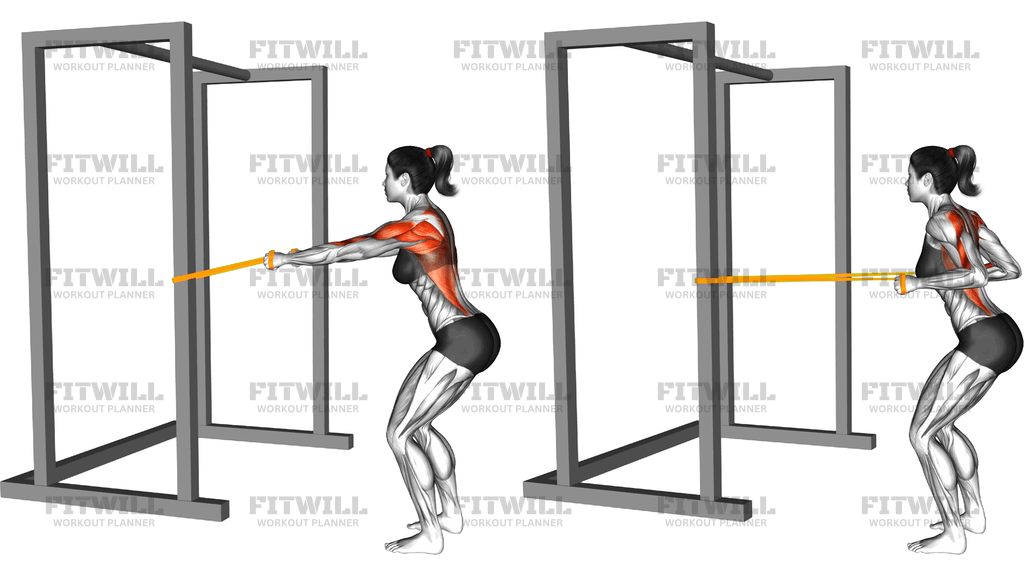
The Resistance Band Standing Row is a horizontal pulling exercise performed on your feet with a resistance band anchored in front of you at roughly waist to chest height. You hold the band's handles with your arms extended toward the anchor, then draw your elbows back past your torso until your hands arrive near your ribs, squeezing your shoulder blades together before controlling the band back to the start. Because you're standing and slightly hinged at the hips, your legs and trunk work quietly in the background to keep you tall and stable while your upper back does the pulling.
This movement is one of the most practical ways to train the muscles between your shoulder blades — the rhomboids and mid-traps — along with the lats, rear shoulders, and biceps. For anyone who spends long hours sitting at a desk, it directly offsets the rounded, forward-rolled shoulder posture that comes from typing and driving. It's also a smart first horizontal row for beginners, since the band's resistance is smooth and forgiving at the start of each rep and easiest to scale of any gym equipment: step farther from the anchor for more tension, closer for less.
Setup matters more than it looks. The band should be secured at a stable anchor point around the height of your navel to lower chest, and it must be firmly attached before you load it — a band slipping off a rack upright mid-rep is the single biggest hazard in this exercise. Your distance from the anchor sets your starting tension, so position yourself so the band already has slight pull when your arms are extended, not slack. A small hip hinge with soft knees and a braced torso gives you a solid base and keeps the pull traveling along the intended path.
To execute well, lead the pull with your elbows, not your hands. Drive them straight back alongside your ribs, keep your wrists neutral, and finish with your chest open and shoulder blades pulled together — not with your shoulders shrugged up to your ears. The return should be just as deliberate as the pull; letting the band snap you forward is where most of the value and control is lost. Exhale as you row, inhale as you extend.
You'll see this movement used in warm-ups before upper-body lifting, in home programs where no cable machine is available, and as a high-rep finisher for back development. It also travels well: loop the band around a squat rack, a sturdy post, or a door anchor and you have a complete rowing station anywhere.
[ Workout Log & Planner ]
Put your next workout in Fitwill
Keep your plan and training log ready when you are.


Instructions
- Anchor the resistance band securely around a stable upright, post, or door anchor at about navel to chest height, and check that it cannot slip or slide before you take up tension.
- Grip one handle in each hand and step back until your arms are fully extended toward the anchor and the band already has light tension — no slack at the start.
- Set your stance about hip-width apart, then hinge slightly forward from the hips with soft knees so your torso leans a few degrees toward the anchor while staying in one straight line from head to hips.
- Brace your core and pull your shoulder blades down and back to set them before the first rep.
- Row by driving your elbows straight back past your sides, keeping them close to your body, until your hands arrive near your lower ribs.
- At the end of the pull, squeeze your shoulder blades together and hold for a beat with your chest open and shoulders away from your ears.
- Slowly extend your arms back toward the anchor over two to three seconds, resisting the band's pull instead of letting it yank you forward.
- Exhale as you pull the handles toward you; inhale as your arms extend back out.
- Complete your reps, then step toward the anchor to release the band tension before letting go of the handles.
Tips & Tricks
- If you feel this mostly in your biceps, your hands are doing the work — think about dragging your elbows back to your ribs and the upper back will take over.
- Shrugging your shoulders toward your ears at the end of each row is the most common fault here; actively press them down as you squeeze your shoulder blades.
- The band should be taut even with your arms extended. If you start each rep from slack, the first third of the pull is wasted — step back until you feel light tension at full reach.
- Keep the hinge constant. If your torso rocks backward as you pull, you're using momentum from your lower back instead of your upper back — reduce the band tension and reset.
- Never stand in line with a stretched band or release it under full tension while facing it; step toward the anchor to slacken it before letting go.
- Wrists bent backward at the finish usually mean the grip is too tight. Hold the handles firmly but loosely enough that your knuckles stay in line with your forearm.
- Pause for one full second with the handles at your ribs on every rep — the band's tension peaks at the top, so that's where the mid-back gets its best stimulus.
- To make the exercise harder, use a thicker band, step farther from the anchor, or slow the return to three seconds. Changing your distance is the fastest way to adjust load mid-set.
- If the band sits noticeably above or below your hands at the anchor, re-set it — an off-angle anchor turns the row into a pulldown or upward pull and changes which muscles lead.
Frequently Asked Questions
What muscles does the Resistance Band Standing Row work?
The primary muscles are the rhomboids and mid-traps of the upper back, which pull your shoulder blades together. The lats, rear shoulders, and biceps assist, and your core and legs stabilize you in the standing hinge position.
How high should the Resistance Band Standing Row anchor be?
Anchor it around navel to lower-chest height so the band pulls horizontally toward your torso. A higher anchor turns it into a downward pull and shifts work away from the mid-back.
How do I make the Resistance Band Standing Row harder or easier?
Step farther from the anchor to increase tension or closer to decrease it — no equipment change needed. You can also switch to a thicker band, hold the squeeze longer, or slow the return phase.
Is the Resistance Band Standing Row good for beginners?
Yes, it's one of the best first rows to learn. The band provides smooth, joint-friendly resistance, the standing position is easy to control, and you can fine-tune the load instantly by adjusting your distance from the anchor.
Why do my shoulders shrug when I do the Resistance Band Standing Row?
Your upper traps are taking over because the pull is too heavy or your elbows are flaring. Lighten the tension, deliberately press your shoulders down before each rep, and focus on pulling your elbows back along your ribs.
Should my torso stay completely upright during the Resistance Band Standing Row?
A slight forward hinge from the hips of roughly 10–20 degrees is ideal and matches how the exercise is typically performed. What matters is that the hinge stays fixed — rocking back and forth as you pull means momentum is replacing muscle work.
Can I do the Resistance Band Standing Row if I don't have handles?
Yes. Loop the band securely around the anchor and grip the ends of the band itself, or thread it through a door anchor and hold the loops. Just make sure your grip cannot slip and the anchor is solid.
How is the Resistance Band Standing Row different from a seated cable row?
Both are horizontal rows, but the band lets tension peak at the strongest point of the pull and requires no machine, while a cable row offers fixed, linear resistance. The standing band version also asks more from your legs and trunk for balance.
How many reps and sets should I do of the Resistance Band Standing Row?
For strength and posture work, 3 sets of 10–15 controlled reps with a pause at the ribs works well. Because band tension is easy to adjust, you can stay in that rep range and simply change your distance from the anchor as you get stronger.
Is it safe to anchor a resistance band to a squat rack for this exercise?
It's safe as long as the band is looped around a solid upright that it cannot slide off, and you inspect the band for nicks or cracks first. Always slacken the band by stepping toward the anchor before letting go, and never release it under stretch while facing it.