Standing Alternating Shoulder Flexion With Rope
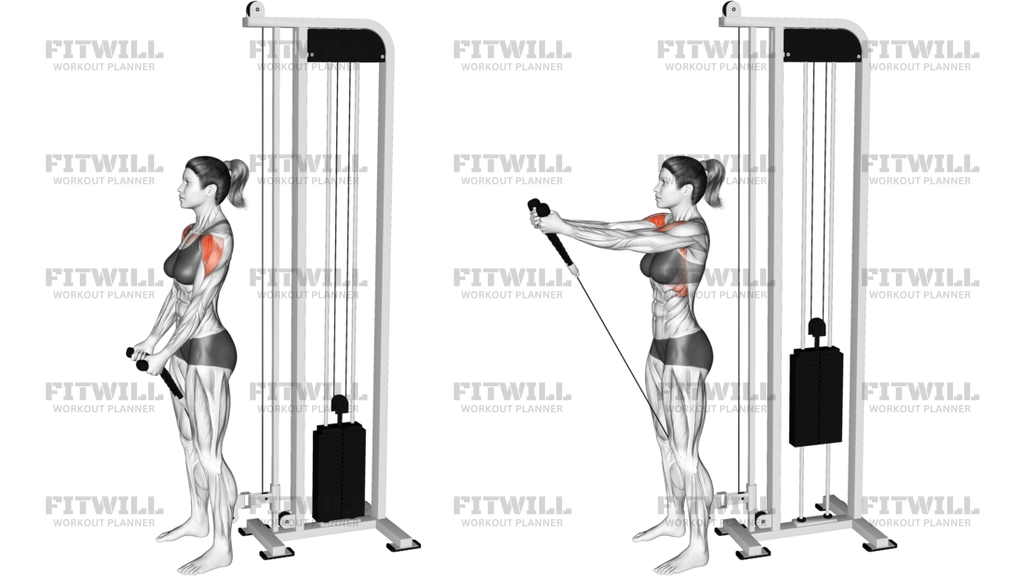
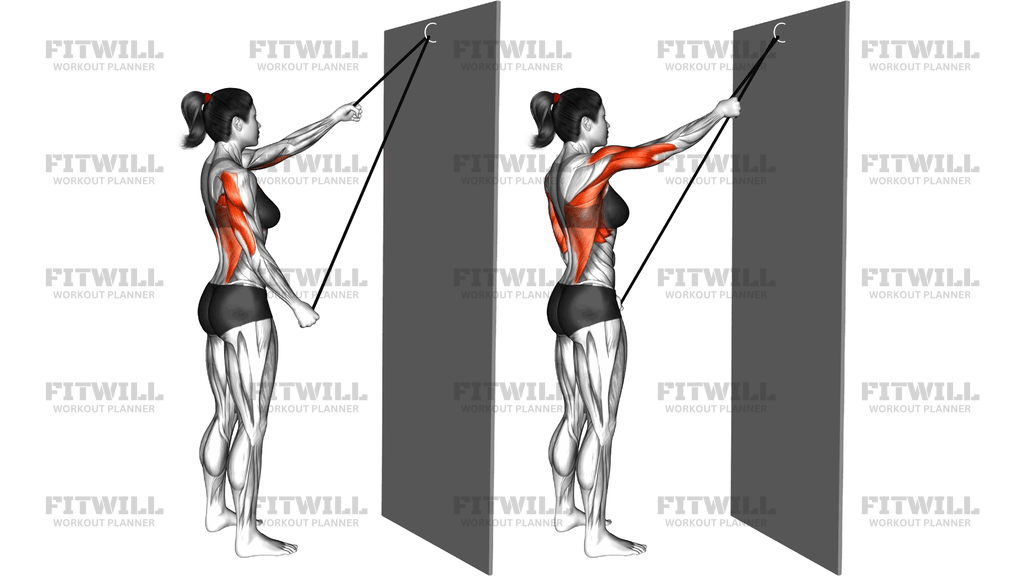
Standing Alternating Shoulder Flexion With Rope is a single-anchor shoulder exercise where a rope or band is fixed overhead and you work one arm at a time through opposite arcs: while one arm pulls down from an overhead position, the other arm raises forward and up against tension. The two arms trade roles on each rep, so one side is flexing upward under load while the other is controlling its return. It is essentially two exercises sharing one strap — a shoulder flexion raise for the ascending arm and a lat-and-delt pull-down for the descending one.
This setup suits people who want shoulder work without heavy equipment: home lifters with a door anchor, beginners building overhead confidence, and anyone rehabilitating or prehabbing the shoulder girdle with smooth, low-load resistance. Because the resistance comes from an anchored line rather than gravity, the tension pulls down and slightly back toward the anchor, which challenges the front shoulders and upper back in a slightly different way than dumbbell raises. The alternating rhythm also keeps both sides honest — your weaker arm cannot hide behind the stronger one.
The overhead anchor point is what defines this movement. With the rope fixed above head height, the arm that starts down must travel through a long forward arc to reach full flexion, and the arm that starts up travels through that same arc on the way down. Keep your torso upright and square so the arms do the work; if you lean back or rotate your chest toward the anchor, you start stealing work from the shoulders and turning it into a torso movement.
Executed well, each rep looks like a slow diagonal hand-off: one hand sweeps up in front of your body to eye level or higher while the other sweeps down to your hip, then they reverse. Move at a pace you could pause at either end. The ascending arm drives with the front and side of the shoulder, while the descending arm resists the upward pull of the rope, which loads the lats and the muscles around the shoulder blade through an eccentric action.
Common use cases are warm-up sequences before pressing, high-rep finisher work for the shoulders, and circulation-friendly training for desk workers whose shoulders spend the day in a slumped position. Start with light tension and moderate reps, and stop the raise at the height where you can keep your ribcage stacked over your pelvis — cranking the arm higher at the cost of an arched lower back defeats the purpose of the exercise.
[ Workout Log & Planner ]
Put your next workout in Fitwill
Keep your plan and training log ready when you are.


Instructions
- Anchor the rope securely at a point above your head, such as a door-frame anchor at the top of a door, and check that the attachment cannot slip before you load it.
- Stand facing sideways to the anchor with feet about hip-width apart, and take one end of the rope in each hand so one arm points up toward the anchor and the other rests down by your hip with the rope taut.
- Set your posture before the first rep: ribs stacked over hips, shoulders relaxed away from your ears, a light brace through the trunk, and a soft bend in both knees.
- Exhale as the low arm sweeps forward and up in a smooth arc in front of your body until your hand reaches roughly eye level or just above, keeping the elbow nearly straight and the palm facing down or slightly inward.
- At the same time, let the high arm pull down along the same diagonal path until its hand arrives at your hip, resisting the rope's pull rather than letting it yank your arm down.
- Pause briefly at the hand-off position — one hand high, one hand low — and check that your torso has not leaned back or twisted toward the anchor.
- Reverse the motion under control: the high arm sinks back toward your hip while the low arm climbs back toward the anchor, each arm staying active through the whole arc instead of collapsing at the turnaround.
- Breathe in on the way down and out as the working arm drives up, keeping the rhythm steady from rep to rep.
- Complete all reps on one starting arm if prescribed, then re-grip and repeat with the opposite arm starting high so both sides get the same work.
Tips & Tricks
- If your shoulder shrugs as the arm rises, lower the top end point an inch or two at a time until you can lift without the upper trap taking over — height is a byproduct of control here, not the goal.
- The rope pulls you up as well as down; the arm returning to your hip should lower at the same speed it rose. If it snaps back, the tension is too heavy for eccentric control.
- Keep your chest facing the side, not the anchor. Rotating the torso toward the anchor shortens the arc for the pulling arm and turns the raise into a twist.
- A slight elbow bend is fine, but if the elbow bends more as the arm fatigues, the set is turning into a partial front raise plus a curl — extend the arm or end the set.
- Stop the raise just below the point where your ribs flare and your lower back arches; bracing the trunk lightly before each rep protects that position.
- If one side noticeably lags in height or control, start your sets with the weaker arm and match the reps on the stronger side rather than doing extra reps unevenly.
- Shorten the rope or take a half-step closer to the anchor if the starting position is already strained; you want tension at the bottom, not a jerky load at the top.
- Because both arms are connected to one anchor, avoid fast, whippy alternations — the slack arm can get jerked around. Smooth tempo keeps both shoulders safe.
Frequently Asked Questions
Which muscles does Standing Alternating Shoulder Flexion With Rope work?
The rising arm is driven mainly by the front and side of the shoulders, with the upper traps and muscles around the shoulder blade assisting. The descending arm resists the rope's upward pull, which loads the lats and upper back eccentrically.
Why is the rope anchored overhead instead of at waist height?
A high anchor lets one arm train upward flexion while the other trains downward pull through the same arc, so both directions of shoulder movement get loaded. A low anchor would change the exercise into a different movement entirely.
Can beginners do Standing Alternating Shoulder Flexion With Rope?
Yes, it is a beginner-friendly choice because the load is light and adjustable and the arc is natural. Start with minimal tension, a shorter range at the top, and slow tempo before adding resistance or reps.
How high should I raise my arm at the top of the movement?
Raise only as high as you can keep your ribs down and your shoulder from shrugging, which for many people is eye level or slightly above. Chasing full overhead height with a flared ribcage shifts work away from the shoulder.
What is the most common mistake in this exercise?
Leaning back or twisting toward the anchor to help the arms through the arc. Keep your torso upright and square so the shoulders and upper back do the moving instead of the trunk.
Can I substitute a cable machine for the anchored rope?
Yes, a single handle at the high pulley of a cable machine replicates the resistance, though you would typically train one arm at a time rather than the alternating hand-off. The rope and door anchor version is simply more portable.
Should both arms move at the same time?
They move at the same time but in opposite directions — one rises while the other lowers, like a diagonal hand-off. If one arm merely goes slack while the other works, slow down and keep tension in both ends of the rope.
Is Standing Alternating Shoulder Flexion With Rope safe for sensitive shoulders?
The smooth, guided arc and light load make it generally shoulder-friendly, but anyone with a current or recent shoulder problem should clear it with a qualified professional first. Pain-free range and light tension are the rules to follow.
How many reps and sets work well for this movement?
Because the resistance is light and the tempo is slow, it fits well at moderate to higher reps, such as 10 to 15 controlled hand-offs per side for 2 to 3 sets. Use it as shoulder warm-up work or as a finisher after pressing.