Side Step Shoulder Circle
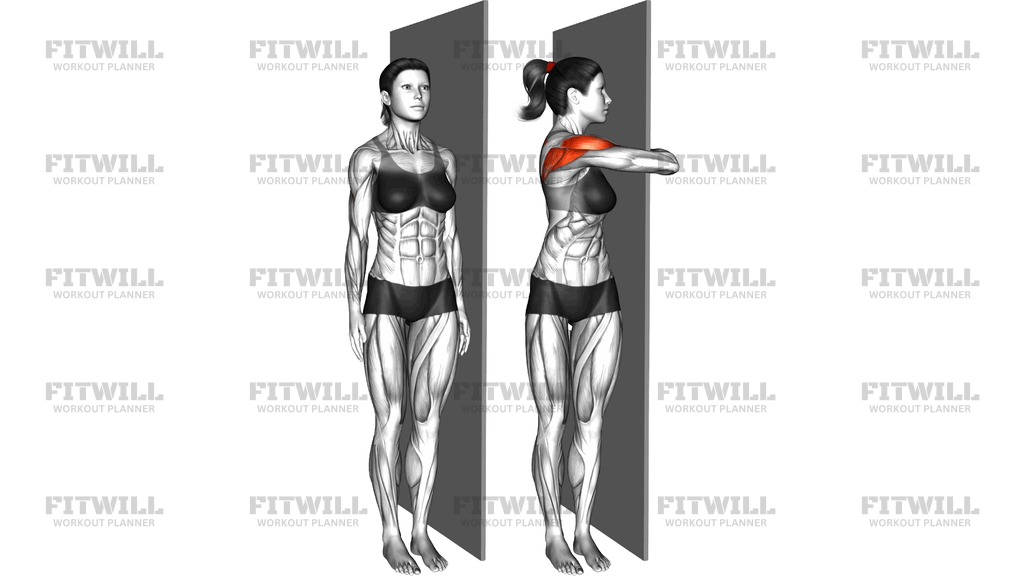
Side Step Shoulder Circle is a rhythmic, no-equipment movement that pairs a lateral side step with large, continuous arm circles. You start with your feet together and arms hanging at your sides, step one foot out into a wide, soft-kneed stance while sweeping both arms in a big circle up and over, then bring your feet back together as the arms finish their rotation. Alternating side to side turns it into a flowing, full-body coordination drill that raises your heart rate while loosening the shoulder girdle.
This movement is especially useful as a dynamic warm-up before upper-body training, group classes, or any workout that demands mobile shoulders and an awake lower body. Because the arms rotate through a large arc while the legs handle a lateral step, it simultaneously preps the deltoids, rotator cuff area, hips, and outer thighs for more loaded work. It also serves well as a low-impact conditioning move on its own — extend the duration and you get a genuine aerobic effect without any jumping.
The setup matters more than it looks. Standing tall with relaxed shoulders before the first step keeps the circles smooth and centered; if you begin hunched or leaning, the arm path drifts behind your body and the shoulders compensate by shrugging. Likewise, a slightly bent knee on each side step lets your hips absorb the weight shift, which keeps the movement friendly to the joints and lets you keep a steady rhythm for longer.
To execute it well, think of the arms and legs as one timing unit: the step out and the upward half of the circle happen together, and the step back in matches the downward half. Keep the circles wide and round — out to the sides, up overhead, then down — rather than small tight loops near your hips. Your torso stays upright and your core lightly braced throughout, so the rotation comes from the shoulder joints, not from rocking your upper back.
Common use cases include warm-up circuits, active recovery days, physical education classes, and low-impact home routines where floor space is limited. Because you only need room to step sideways and raise your arms, it fits almost anywhere. Coaches also like it for teaching rhythm and cross-body coordination, since the timing of the step and the circle forces the brain and body to sync.
For safety, keep the pace moderate until the arm path feels natural. If your shoulders feel pinched at the top of the circle, shrink the arc slightly rather than forcing the arms straight overhead. Land each side step with control instead of slamming the foot down, and stop if you feel any sharp shoulder or knee discomfort — smooth and repeatable beats big and forced every time.
[ Workout Log & Planner ]
Put your next workout in Fitwill
Keep your plan and training log ready when you are.


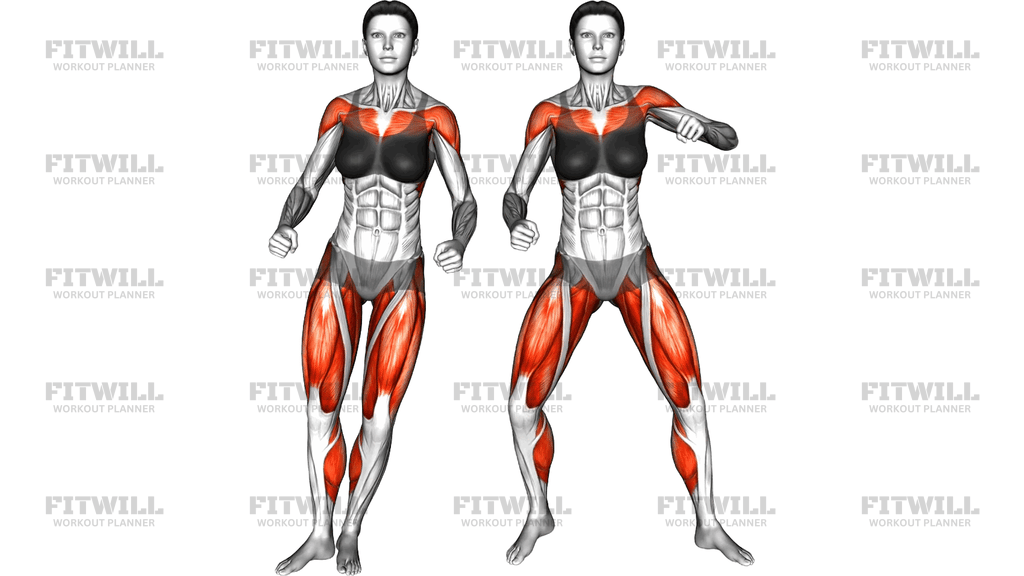
Instructions
- Stand tall with your feet together, arms relaxed at your sides, hands in loose fists, and your gaze straight ahead.
- Brace your core lightly, roll your shoulders back and down once, and settle into an upright posture before moving.
- Step one foot out wide to the side, letting both knees bend slightly as your weight shifts into the wide stance.
- As you step out, sweep both arms out to the sides and up in a large forward circle, reaching toward overhead at the top of the arc.
- Continue the circle so your arms sweep back down to your sides as you push off the wide foot and bring your feet back together.
- Immediately repeat on the opposite side, stepping out with the other foot while starting the next arm circle.
- Keep your knees soft and tracking over your toes on every side step, and keep your torso upright without leaning toward the stepping leg.
- Exhale as you step out and raise the arms, and inhale as you step back in and lower them.
- After 30 seconds or a set number of reps, reverse the direction of the arm circles to rotate the shoulders the opposite way.
- Finish by stepping your feet together, letting your arms settle, and shaking out your shoulders before the next exercise.
Tips & Tricks
- If your shoulders creep up toward your ears during the circles, deliberately press your shoulder blades down before each rep — shrugging is the most common fault in this movement.
- Keep the circles in front and to the side of your body; letting the arms swing behind your hips changes the shoulder path and loses the mobility benefit.
- Make the circle genuinely round — a common mistake is cutting the top short and doing small loops at chest height. Reach until the arms are nearly overhead.
- Land each side step toe-first and softly; a heavy heel slap usually means you are stepping wider than your hips can control.
- Do not straighten and lock your knees as your feet come back together — keep a small bend so the rhythm stays fluid.
- If your timing falls apart, slow the legs down and let the arms set the tempo; the step should land exactly when the arms reach the top of the circle.
- Keep your weight even between both feet in the wide stance. Shifting all your weight onto the stepping leg tilts the torso and strains the supporting hip.
- Start with smaller circles if your shoulder mobility is limited, then widen the arc over sessions rather than forcing full overhead reach on day one.
- Breathe in a steady cycle matched to the steps — holding your breath is a sign the pace is too fast for your current control.
Frequently Asked Questions
Which muscles does the Side Step Shoulder Circle work?
The shoulder muscles, especially the deltoids, drive the arm circles, while the glutes, quads, and outer hips handle the side stepping. Your core stays engaged to keep the torso upright through the weight shifts.
Is the Side Step Shoulder Circle good for beginners?
Yes. It is low impact, requires no equipment, and the intensity is fully controlled by your step width, circle size, and pace. Beginners should start with smaller circles and a slower rhythm before speeding up.
Should I circle my arms forward or backward during the Side Step Shoulder Circle?
Forward circles are the standard version and the best place to start. Backward circles are a useful variation that biases the rear shoulder and upper back, so you can alternate directions within the same set.
Why do my knees need to bend on the side step?
A soft knee lets your hips absorb the weight shift as you land in the wide stance, which keeps the movement smooth and reduces strain on the knee joint. Stiff-legged steps make the landing abrupt and throw off your rhythm.
How is the Side Step Shoulder Circle different from jumping jacks?
Jumping jacks use a hop and a vertical arm swing, while this movement steps laterally with one leg at a time and rotates the arms in a full circle. That makes it lower impact and more focused on shoulder mobility and hip control.
How many repetitions should I do?
For a warm-up, 30 to 60 seconds of continuous alternating steps works well, or about 10 to 20 reps per side. For a conditioning set, go for one to two minutes and switch the circle direction halfway through.
Can I do the Side Step Shoulder Circle if my shoulders are stiff?
Usually yes — just reduce the size of the circle so your arms stay below or near shoulder height, and keep the movement pain-free. The wide, smooth arc can gradually be expanded as your range improves.
Do I need any equipment or much space?
No equipment is needed, and you only need enough room to step roughly a leg's width to each side and raise your arms overhead. Clear the area of obstacles so you can step confidently.
Can I add resistance to this movement?
Light wrist weights or very light dumbbells can be used once your form is consistent, but keep the load minimal. The value of the exercise comes from smooth, continuous circles, not from force.
What should I do if my circles and steps fall out of sync?
Slow down and let the arm circle dictate the timing — step out as the arms rise and step in as they descend. Practicing at half speed for a few reps usually locks the coordination in.