90 To 90 (Beginner)
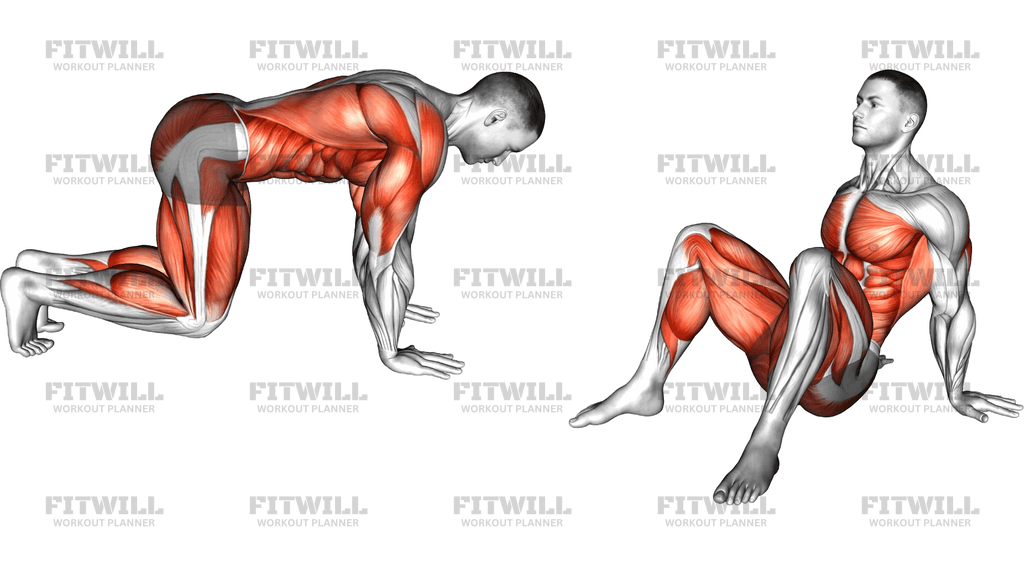
The 90 To 90 is a seated hip mobility drill in which both legs are bent to roughly right angles — one in front of you, one out to the side — and you rotate your knees from one side to the other without letting your hands do the work. Each knee lands at 90 degrees of flexion while the corresponding hip sits at 90 degrees of rotation, which is exactly where the exercise gets its name. It is one of the most efficient ways to work internal and external hip rotation in a single flowing movement.
This drill is especially useful for anyone who sits for long hours, runners, lifters with stiff hips, and beginners building a foundation for deep squats or lunges. Because it is performed on the floor with no load, it is a safe entry point into hip mobility work, and the beginner version lets you support yourself lightly with your hands behind you while you learn the positions.
The main work happens in the hips: the front leg challenges external rotation through the glutes and deep hip rotators, while the back leg challenges internal rotation through the adductors and hip flexor group. Your core stays engaged the whole time to keep your torso upright, which is why the abdominal wall lights up more than most people expect from a floor mobility drill.
Setup matters more than speed here. Sit tall with a neutral spine rather than slumping back onto your hands, and place your legs so both shins form true right angles. If your torso leans or your hips dump to one side, the target hip never actually reaches the end range, and the drill loses most of its value. Quality of position beats range of motion every time.
To execute well, shift your weight over the front leg, lift both knees a few centimeters off the floor, and rotate them together to the opposite side, landing softly back into the mirror-image 90/90 position. Move slowly, keep the chest tall, and avoid letting the pelvis twist. The hands behind you are there for balance on the beginner version, but try to gradually rely on them less as your control improves.
Use the 90 To 90 as a warm-up before lower-body training, as a standalone daily mobility habit, or as a cooldown stretch after running or leg day. Two to three sets of five to eight controlled switches per side is a realistic starting dose. If a position causes pinching in the groin or front of the hip, reduce the range or elevate your hips on a folded mat rather than pushing through discomfort.
[ Workout Log & Planner ]
Put your next workout in Fitwill
Keep your plan and training log ready when you are.


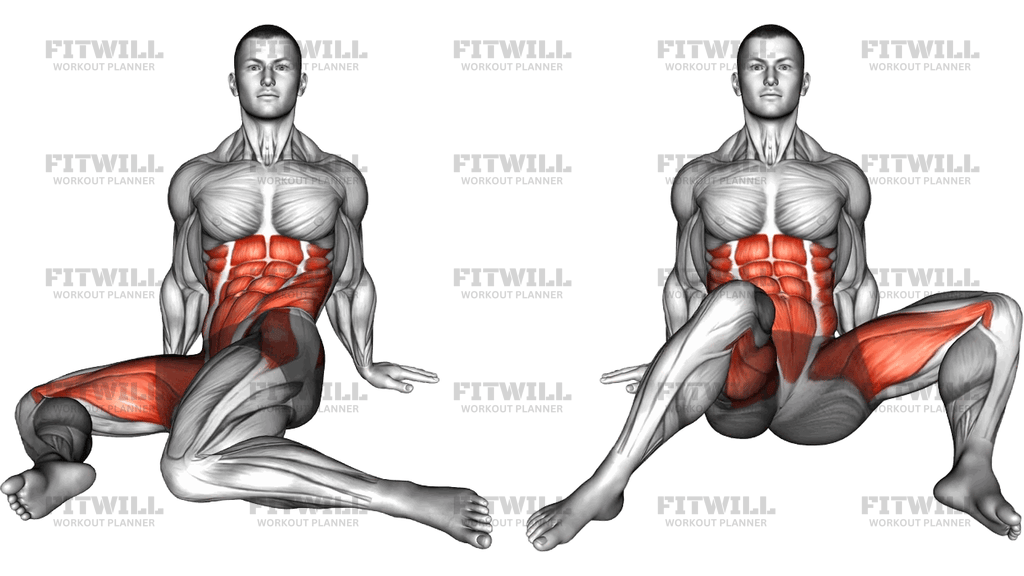
Instructions
- Sit on the floor with your legs bent and placed in the 90/90 position: front leg bent to 90 degrees in front of you with the shin parallel to your chest, back leg bent to 90 degrees out to the side with the shin parallel to the wall behind you.
- Place your hands on the floor slightly behind your hips for light support, and sit as tall as you can with your ribs stacked over your pelvis.
- Brace your core gently and press both legs evenly into the floor so your weight feels balanced between the front hip and the back hip.
- Shift your bodyweight slightly toward the front leg so most of your load moves over that hip.
- Lift both knees a few centimeters off the floor by driving through the front foot and keeping the torso upright.
- Rotate both knees together across your body to the opposite side, landing in the mirror-image 90/90 position with the other leg now in front.
- Pause briefly in the new position, checking that both shins still form right angles and your chest stays tall.
- Reverse the movement the same way — weight shift, knees up, rotate — to return to the original side, completing one repetition.
- Exhale as you switch and inhale as you settle into each position, keeping the breath steady throughout.
- Complete all repetitions on one lead or alternate sides each rep, then reset your leg positions and posture before the next set.
Tips & Tricks
- If your hips sit behind your shoulders, you are leaning on your arms too much — walk your hands closer to your hips and think about growing taller out of the top of your head.
- A collapsing front arch or a knee floating off the floor on the front leg usually means limited external rotation; reduce how far you rotate until both knees can touch down together.
- Pinching at the front of the hip on the back leg is a common sign of forcing internal rotation; back off a few degrees and slightly widen the angle of the back shin.
- Keep both sitting bones pointing at the wall in front of you — if your pelvis rotates with your legs, the hips stop doing the work and your lower back takes over.
- Start with a slow three-second switch per side; rushing turns this into a leg-swing exercise and skips the end ranges where the mobility benefit lives.
- Elevating your hips on a folded mat or low cushion is a legitimate beginner modification, not a shortcut — it removes tension so you can hold an upright torso.
- Watch that the back foot stays flat and in contact with the floor; a lifting heel usually means the whole leg has drifted out of the 90-degree shape.
- Do this drill before squats, lunges, or running rather than only after training — open hips going into a session move better than hips you try to pry open afterward.
Frequently Asked Questions
What muscles does the 90 To 90 work?
It primarily targets the hip rotators — the glutes and deep external rotators on the front leg, and the adductors and hip flexors on the back leg. The core works isometrically to keep your torso upright through each switch.
Is the 90 To 90 suitable for complete beginners?
Yes, and the beginner version is specifically designed for that. Supporting yourself lightly with your hands behind you lowers the balance demand while you learn the two leg positions and the switching pattern.
Why are both legs bent to 90 degrees in the 90 To 90?
The two right angles put the front hip in external rotation and the back hip in internal rotation at the same time. That setup trains both rotation directions in one drill, which is what makes it so time-efficient.
My groin pinches when I switch sides — should I push through it?
No, pinching is a signal to reduce the range or adjust the setup. Try elevating your hips on a mat, making your leg angles slightly wider, or rotating less far until the pinch disappears.
Can I use my hands to help me through the switch?
Light hand support is fine in the beginner version for balance, but avoid pushing off the floor to power the rotation. The knees should lead the movement so the hips, not the arms, do the work.
How is the 90 To 90 different from a butterfly or seated groin stretch?
A butterfly stretch holds a static position, while the 90 To 90 is an active drill where you rotate from one hip position to its opposite. It builds control through the range, not just passive flexibility.
How many reps and sets should I do?
Start with two to three sets of five to eight controlled switches, resting briefly between sets. As the movement becomes smooth, you can add reps or slow the tempo rather than adding load.
Can the 90 To 90 replace stretching before a workout?
It works well as the hip-mobility portion of a warm-up, ideally paired with a few squats or lunges to use the new range. It should not be your entire warm-up if you are training the whole body.
I cannot get my back knee to touch the floor — is that a problem?
It is common and usually just reflects limited internal rotation. Keep the knee as close to the floor as you can without force, and the range typically improves with consistent practice over weeks.